







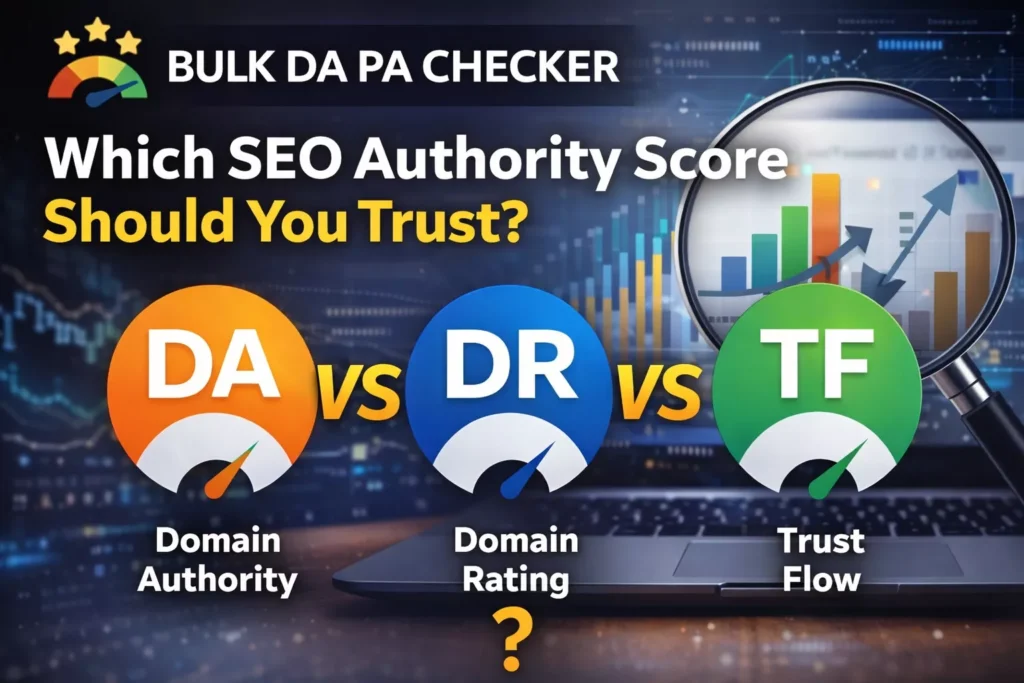
SEO authority scores are third-party metrics that estimate a website or page’s ability to rank in search engines based on backlink quality and quantity. Popular scores include Domain Authority (DA), Page Authority (PA), Domain Rating (DR), URL Rating (UR), Trust Flow (TF), and Citation Flow (CF). These metrics are created by SEO tools—not Google—to help professionals evaluate link strength and ranking potential.
If you’ve been working in SEO long enough, you’ve probably been asked:
“What’s your DA?”
“Is the DR high?”
“What’s the TF/CF ratio?”
For professionals in India’s competitive digital landscape, whether you’re handling enterprise clients, local businesses, or affiliate projects, understanding SEO authority scores is critical. But here’s the truth:
Most people use these metrics without fully understanding what they actually measure. Let’s clear the confusion once and for all.
What Are SEO Authority Scores in Simple Terms?
SEO authority scores are proprietary metrics developed by tools like Moz, Ahrefs, and Majestic to estimate how strong a website or page is based on backlinks. They do not come from Google, but they help SEOs compare websites and predict ranking potential.
These metrics are calculated using:
Number of backlinks
Referring domains
Link quality
Link trust
Link velocity
Popular tools that provide these scores:
Moz → DA, PA, Spam Score
Ahrefs → DR, UR
Majestic → TF, CF
Now let’s break them down individually.
Domain Authority (DA) vs Domain Rating (DR)
Domain Authority (DA) is a Moz metric (0–100 scale) that predicts how likely a domain is to rank in search results based on backlink profile strength.
DA considers:
Linking root domains
Total backlinks
MozRank & MozTrust
Spam signals
Higher DA = stronger perceived ranking ability. Top-ranking pages have 3.8× more backlinks than pages in positions 2–10 on Google, showing a strong correlation between backlinks and ranking positions. Source: Backlinko
What Is Domain Rating (DR)?
Domain Rating (DR) is an Ahrefs metric (0–100 scale) that measures the strength of a website’s backlink profile compared to others in Ahrefs’ database.
DR focuses primarily on:
Number of referring domains
Quality of linking domains
Link equity distribution
DA vs DR – What’s the Real Difference?
| Factor | DA (Moz) | DR (Ahrefs) |
|---|---|---|
| Tool | Moz | Ahrefs |
| Focus | Predictive ranking ability | Backlink strength |
| Calculation | Machine learning model | Link-based algorithm |
| Update Frequency | Periodic | More frequent |
Key Insight for Indian SEO Professionals
DR is often more backlink-focused and transparent.
DA attempts to model ranking potential using predictive signals.
Both are relative metrics—not absolute truths.
If you’re doing competitive research or using a bulk da pa checker, comparing both metrics gives better clarity.
Page Authority (PA) vs URL Rating (UR)
Page Authority (PA) is Moz’s metric that predicts how well a specific page (not domain) can rank in search engines.
It evaluates:
Page-level backlinks
Internal linking
Link quality
According to aiseo Only about 6–7% of all published pages ever get even one external backlink, meaning 94–95% of pages have zero backlinks
What Is URL Rating (UR)?
URL Rating (UR) is Ahrefs’ metric that measures the strength of a specific page’s backlink profile on a 0–100 scale.
UR focuses more directly on:
Page backlinks
Link authority passed
Internal + external links
PA vs UR – Which Is Better?
For professionals:
UR is more link-equity focused
PA is more predictive
When evaluating guest post placements in India’s competitive niches (finance, edtech, SaaS), UR is often more practical for link value assessment.
Trust Flow (TF) & Citation Flow (CF)
Trust Flow (TF) is a Majestic metric that measures how trustworthy a website is based on the quality of sites linking to it.
High TF means:
Links from authoritative, clean websites
Less spam influence
What Is Citation Flow?
Citation Flow (CF) measures the quantity of backlinks a site has, without focusing on quality.
High CF means:
Many backlinks
But not necessarily trustworthy ones
TF vs CF – The Ratio Matters
The TF/CF ratio is critical.
Healthy ratio → Close to 1:1
Very high CF + low TF → Possible spam
For link-building campaigns in India, especially when buying placements, checking TF/CF is essential.
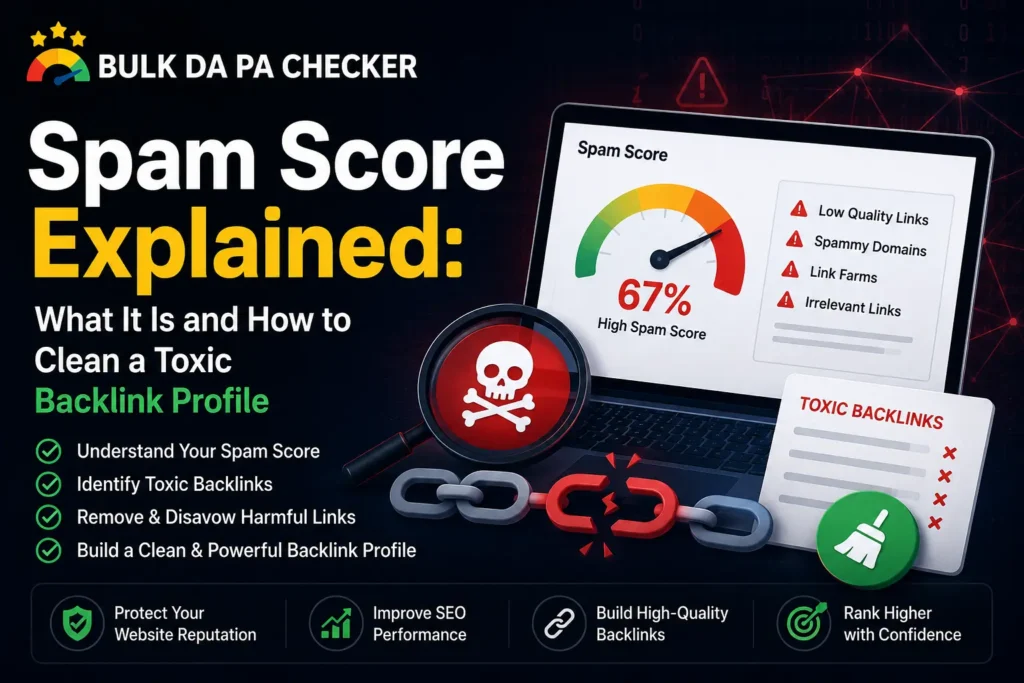
What Is Spam Score?
Spam Score is a Moz metric that estimates the likelihood of a domain being penalized or flagged as spam.
It analyzes:
Link patterns
Thin content signals
Over-optimization
Toxic linking behavior
High Spam Score = Risky backlink source.
Before using any da pa bulk checker, always cross-check the Spam Score to avoid toxic domains.
Which Metric Does Google Actually Use?
Here’s the honest answer:
Google does NOT use DA, DR, TF, CF, or Spam Score.
These are third-party metrics.
Google uses:
PageRank (internally)
Relevance
Content quality
E-E-A-T signals
User behavior
Core Web Vitals
Contextual backlinks
As confirmed multiple times by Google representatives, DA and DR are not ranking factors.
Which Authority Metric Should SEOs Trust?
Short Answer: None blindly.
Professional Recommendation:
Use authority metrics as comparative indicators, not ranking guarantees.
Best Practical Approach:
For backlink quality → Check DR + TF
For domain comparison → Use DA + DR
For page-level link power → Use UR
For spam filtering → Use Spam Score + TF/CF ratio
For agencies handling multiple sites, using a bulk da pa checker free tool can speed up competitor audits and prospect evaluation.
Instead of relying on one metric:
Use a combination + contextual judgment.
How Indian SEO Professionals Should Use Authority Scores
In India’s hyper-competitive SEO market:
For Link Building:
Avoid domains with high CF but low TF
Don’t rely solely on DA 50+ sites
Check traffic using Ahrefs/Semrush
For Client Reporting:
Use DA/DR trends over time
Show backlink growth
Highlight the referring domain quality
For Competitor Analysis:
Using tools like a bulk dapa checker, you can quickly:
Compare authority metrics
Identify link gaps
Find outreach targets
If you manage multiple domains, tools like a bulk DA PA checker simplify large-scale audits.
You can use platforms like Bulk DA PA Checker to check DA, PA, DR, TF, and CF in bulk and streamline competitor research.
Common Mistakes Professionals Make
Chasing high DA sites without checking relevance
Ignoring traffic metrics
Not checking spam signals
Overvaluing DR over contextual relevance
Using authority scores as ranking guarantees
Authority ≠ Rankings. Relevance + Quality = Rankings.
Final Verdict: What Really Matters?
Authority metrics are:
✔ Useful for comparison
✔ Helpful in link-building
✔ Good for reporting
But they are:
✖ Not official Google metrics
✖ Not direct ranking factors
The smartest SEO professionals in India treat DA, DR, TF, CF as diagnostic tools—not goals.
FAQs
1. What is the difference between DA and DR?
Answer:
Domain Authority (DA) is a Moz metric that predicts how likely a domain is to rank in search results, while Domain Rating (DR) is an Ahrefs metric that measures the strength of a website’s backlink profile. DA focuses on ranking potential, whereas DR focuses primarily on link authority.
2. Is DA more important than DR?
Answer:
Neither DA nor DR is officially used by Google. Both are third-party metrics designed to estimate link strength and ranking potential. SEO professionals should use them comparatively rather than treating one as more important than the other.
3. What is the difference between PA and UR?
Answer:
Page Authority (PA) measures a specific page’s ranking potential using Moz’s algorithm, while URL Rating (UR) measures the strength of a page’s backlink profile using Ahrefs data. PA is predictive, whereas UR is more backlink-focused.
4. What is Trust Flow and Citation Flow?
Answer:
Trust Flow (TF) measures the quality and trustworthiness of backlinks, while Citation Flow (CF) measures the quantity of backlinks. A healthy TF/CF ratio indicates balanced and credible link building, while high CF with low TF may signal spam.
5. What is a good TF and CF ratio?
Answer:
A good TF to CF ratio is close to 1:1. For example, TF 20 and CF 25 is considered healthy. If Citation Flow is significantly higher than Trust Flow, it may indicate low-quality or spammy backlinks.
6. Does Google use DA, DR, TF, or CF?
Answer:
No, Google does not use Domain Authority, Domain Rating, Trust Flow, or Citation Flow as ranking factors. These are third-party metrics created by SEO tools. Google uses its own internal ranking systems, including PageRank and quality signals.
7. Which SEO authority metric should professionals trust?
Answer:
SEO professionals should not rely on a single authority metric. Instead, use a combination of DR, DA, TF, UR, and Spam Score along with traffic data and relevance analysis to evaluate link quality accurately.
8. What is Spam Score in SEO?
Answer:
Spam Score is a Moz metric that estimates the likelihood of a domain being penalized or associated with spammy practices. A high Spam Score suggests risky backlink patterns and should be reviewed before acquiring links.
9. What is a good Domain Authority score?
Answer:
A good Domain Authority score depends on your niche and competitors. In competitive industries, a DA above 50 is strong, while in smaller niches, DA 30–40 may already be competitive. Always compare DA relative to competitors.
10. How can I check DA, PA, DR, TF, and CF in bulk?
Answer:
You can use a bulk DA PA checker tool to analyze multiple domains at once. These tools allow SEO professionals to compare authority metrics quickly and streamline competitor research and backlink evaluation.