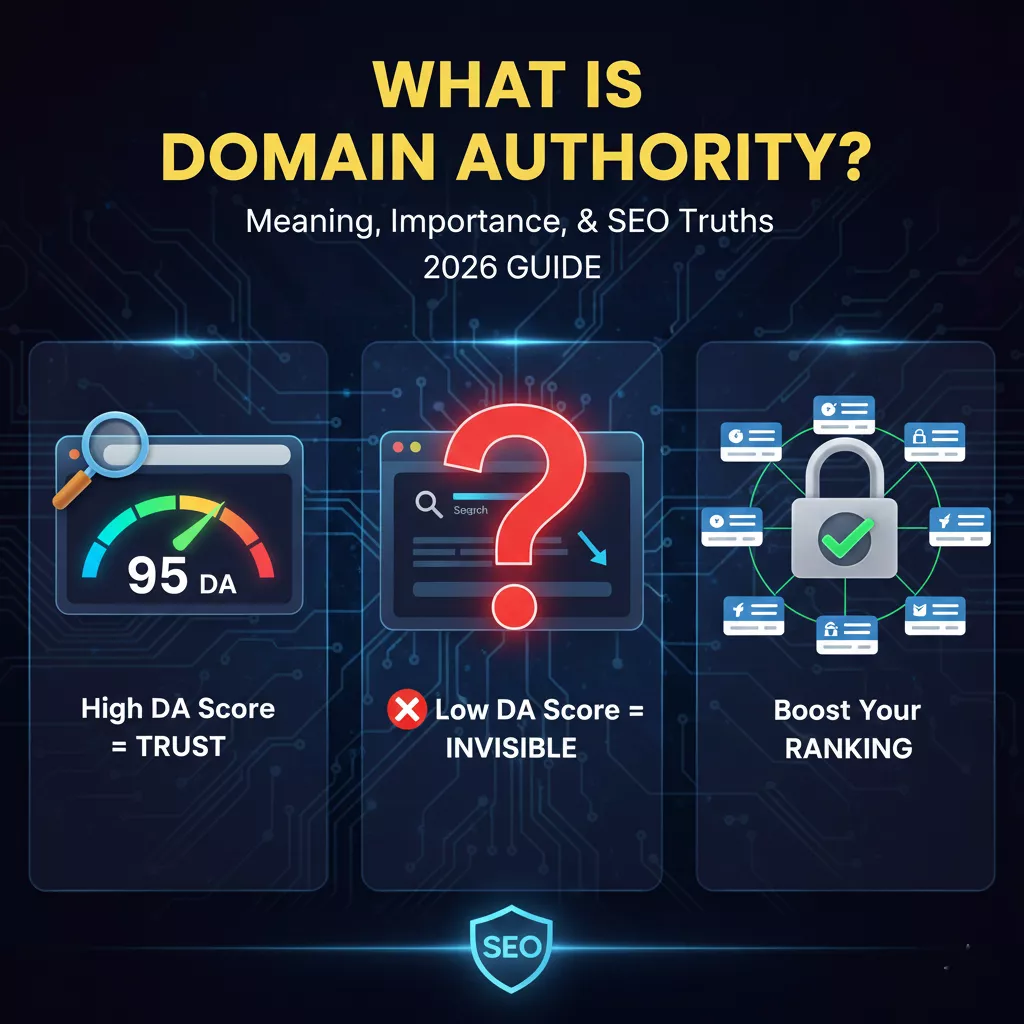
Domain Authority is a comparative SEO metric that estimates a website’s ranking strength based on backlink quality and authority signals. It is not used by Google directly, but it remains useful for competitor analysis, link evaluation, and long-term SEO planning. Strong content and high-quality backlinks are the real drivers behind authority growth.
This guide explains Domain Authority in simple terms, clears up common myths, and shows how to use it correctly for SEO, competitor analysis, and website growth in 2026.
What Is Domain Authority?
Domain Authority, often abbreviated as DA, is a search engine optimisation metric that predicts how likely a website is to rank in search engine results compared to other websites. It is measured on a scale from 1 to 100, with higher scores indicating stronger ranking potential.
Domain Authority is not a Google metric. It is a comparative score created by SEO tool providers to help estimate a website’s overall strength based on multiple signals.
In simple terms, Domain Authority answers this question:
How strong is this website compared to others in search results?
Who Created Domain Authority?
Domain Authority was originally introduced by Moz as a way to estimate ranking strength using machine learning models. Today, similar authority metrics exist across different SEO platforms, each using its own methodology.
Although the name and calculation methods vary, the purpose remains the same: to compare websites and understand relative SEO strength.
How Domain Authority Is Calculated
Domain Authority is calculated using multiple signals rather than a single factor. While exact formulas are proprietary, most tools rely on a combination of the following elements:
Backlink quantity and quality
Referring domains and link diversity
Link relevance and authority
Spam signals and link trust
Overall link profile strength
The score is logarithmic, which means moving from 10 to 20 is far easier than moving from 70 to 80. This is why established websites see slower growth at higher levels.
Domain Authority is best used as a comparative metric rather than a standalone performance indicator.
Is Domain Authority a Google Ranking Factor?
No. Domain Authority is not a direct Google ranking factor.
Google has publicly stated that it does not use third-party metrics like Domain Authority in its ranking algorithms. Instead, Google relies on its own internal signals such as content relevance, backlinks, page experience, and trust signals.
However, Domain Authority correlates with rankings because it is built using similar external signals, especially backlinks. Websites with strong link profiles tend to rank better, which is why Domain Authority often appears to “predict” performance.
Correlation does not mean causation, but the relationship is still useful for analysis.
Why Domain Authority Still Matters for SEO
Even though Google does not use Domain Authority directly, the metric remains valuable for several SEO tasks.
It helps you compare your site with competitors
It makes backlink evaluation faster
It helps prioritise outreach opportunities
It supports SEO audits and benchmarking
It provides a simple way to track authority growth over time
For agencies and site owners managing multiple websites, Domain Authority is a practical way to assess relative strength without deep manual analysis.
What Is a Good Domain Authority Score?
There is no universally “good” Domain Authority score. The right benchmark depends on your niche, competition, and website age.
As a general reference:
New websites often start below 10
Small blogs commonly range between 10 and 30
Established content sites often sit between 30 and 60
Large brands and authority publishers exceed 70
The most important comparison is not against global websites, but against your direct competitors in search results.
If your competitors average a score of 35 and your site is at 20, you have a measurable authority gap to close.
Why Domain Authority Changes Over Time
Domain Authority is dynamic and recalculated regularly. It can increase or decrease even if you make no changes to your site.
Common reasons include:
New backlinks gained or lost
Competitors are improving faster than you
Index updates by the tool provider
Removal of spam or low-quality links
Changes in link relevance or trust
A drop in Domain Authority does not automatically mean a Google penalty. It often reflects relative shifts in the broader web ecosystem.
Common Domain Authority Myths
Many SEO mistakes come from misunderstanding what Domain Authority represents.
One common myth is that increasing Domain Authority directly increases rankings. In reality, rankings improve because of stronger backlinks and better content, not because the score itself increases.
Another myth is that Domain Authority should be tracked daily. Because it is a relative metric, short-term fluctuations are normal and often meaningless.
Some believe Domain Authority applies equally to every page. In practice, individual pages rank based on their own signals, not the site’s overall score.
Domain Authority vs Page Authority
Domain Authority measures the overall strength of an entire domain. Page Authority focuses on the ranking potential of a single page.
A website with moderate Domain Authority can still rank individual pages well if those pages earn strong links and match search intent. This is why content quality and page-level optimisation remain critical.
Both metrics are best used together rather than in isolation.
How to Use Domain Authority Correctly
The most effective way to use Domain Authority is as a decision-making aid, not a performance goal.
Use it to evaluate backlink opportunities
Use it to compare competitors
Use it to prioritise outreach targets
Use it to track long-term authority trends
Avoid using Domain Authority as the sole success metric. Rankings, organic traffic, conversions, and engagement always matter more.
Does Domain Authority Matter for AI Search and AI Overviews?
AI-powered search systems rely heavily on authority and trust signals when selecting sources. While they do not use Domain Authority scores directly, they evaluate similar factors such as backlinks, reputation, content depth, and consistency.
Websites with strong authority signals are more likely to be referenced in AI-generated summaries, featured answers, and chatbot responses.
This makes authority-building strategies increasingly important in the era of AI-driven search.
Conclusion
Domain Authority is not a ranking shortcut, but it is a powerful indicator of how competitive your website is in search results. When used correctly, it helps you compare competitors, evaluate backlink opportunities, and understand where your SEO efforts should focus next.
Instead of chasing the score itself, focus on improving the signals behind it, such as high-quality backlinks, relevant content, and strong internal linking. As those fundamentals improve, your Domain Authority will grow naturally.
Tools like BulkDAPA make this process easier by allowing you to check Domain Authority and Page Authority for multiple websites at once. Whether you are analysing competitors, auditing backlinks, or managing SEO campaigns at scale, BulkDAPA.site helps you make faster, data-driven decisions without relying on guesswork.
In modern SEO and AI-driven search, authority and trust matter more than ever. Use Domain Authority as a guide, not a goal, and combine it with smart content and link strategies for long-term growth.
Frequently Asked Questions About Domain Authority
What is Domain Authority in simple terms?
Domain Authority is a score that estimates how strong a website is compared to others based on backlinks and authority signals. Higher scores usually indicate better ranking potential.
Does Google use Domain Authority to rank websites?
No. Google does not use Domain Authority directly. It is a third-party metric, but it reflects signals that Google does value, such as backlinks and trust.
What is a good Domain Authority score?
A good score depends on your niche and competitors. New websites often start below 10, while established sites commonly range between 30 and 60.
Why does my Domain Authority change even without updates?
Domain Authority changes because it is relative. If competitors gain links or the tool updates its index, your score may fluctuate without any changes on your site.
How often should I check Domain Authority?
Checking once or twice a month is enough. Daily tracking is unnecessary and can be misleading due to normal fluctuations.
Can Domain Authority affect AI search results?
AI systems do not use the score itself, but they rely on authority signals like backlinks, reputation, and content depth, which Domain Authority helps estimate.
Is Domain Authority more important than content quality?
No. High-quality content is essential. Domain Authority reflects external trust, while content relevance and usefulness drive actual rankings.
How can I check Domain Authority in bulk?
You can use tools like BulkDAPA.site to check Domain Authority and Page Authority for multiple websites at once, saving time during SEO audits.