The rules of search have changed, and they changed fast.
Google’s AI Overviews, Search Generative Experience (SGE), and the rapid rise of answer engines like Perplexity and ChatGPT Search have fundamentally shifted what it means to “rank.” Traditional SEO tactics alone aren’t enough anymore. Today, the marketers pulling ahead are the ones leveraging AI search optimization tools, platforms that don’t just track rankings, but actively help you dominate them.
But with hundreds of tools flooding the market, there’s a real risk of investing in the wrong ones, over-relying on automation, or simply not understanding what these tools actually do under the hood.
This guide cuts through the noise. You’ll get a clear, professional breakdown of what AI search optimization tools are, how they work, how they differ from legacy SEO software, and exactly how to choose the right stack for your workflow in 2026.
What Are AI Search Optimization Tools?
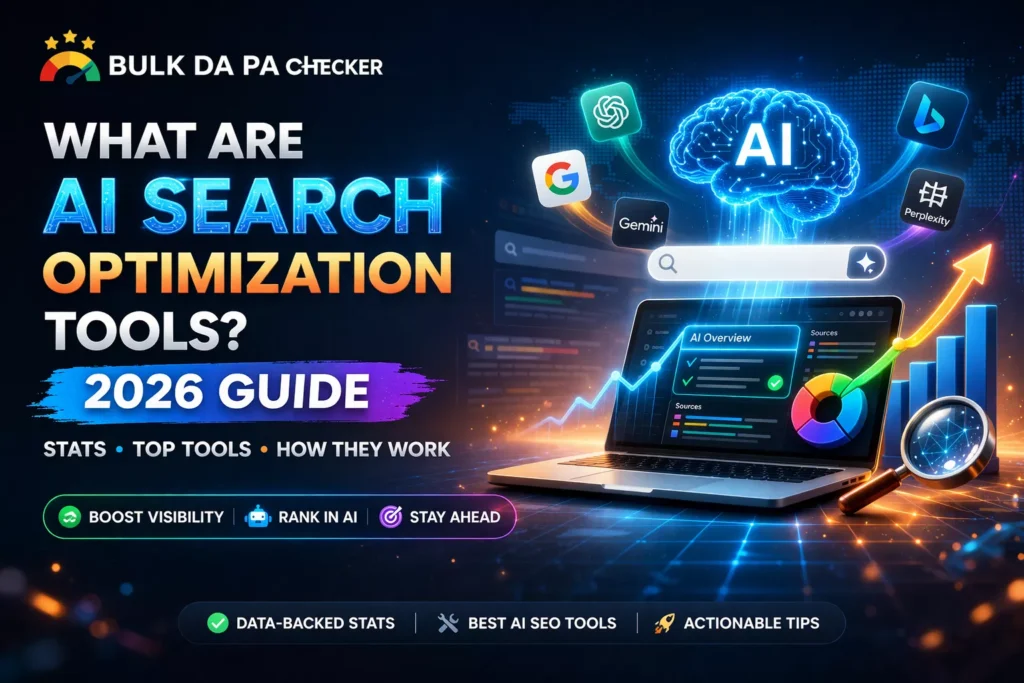
Quick Answer: AI search optimization tools are platforms powered by artificial intelligence that help marketers improve their website’s visibility in search engines. They automate tasks like keyword research, content analysis, technical audits, and competitive intelligence, using machine learning to surface insights that would take humans hours or days to uncover manually. In 2026, they also optimize for AI-generated search results and answer engines, not just traditional blue-link rankings.
At their core, AI search optimization tools sit at the intersection of data science and digital marketing. They ingest massive volumes of search data, SERPs, backlink profiles, content quality signals, and user behavior metrics and use AI models to interpret that data and recommend action.
Key Functions They Perform:
- Semantic keyword research — identifying topic clusters, search intent, and LSI (Latent Semantic Indexing) terms beyond surface-level keywords
- Content optimization — scoring your content against top-ranking pages and suggesting improvements in real time
- Technical SEO auditing — detecting crawl errors, Core Web Vitals issues, and indexing problems automatically
- Competitor intelligence — analyzing what’s working for competing domains and surfacing gap opportunities
- SERP feature targeting — optimizing for featured snippets, People Also Ask boxes, AI Overviews, and knowledge panels
- Rank tracking & forecasting — predicting ranking movements based on algorithmic patterns and content changes
Think of them not as a replacement for SEO expertise, but as a force multiplier; they let skilled marketers work at a scale and speed that simply wasn’t possible five years ago.
Read Also: Are Social Signals a Google Ranking Factor?
How AI Search Optimization Tools Differ From Traditional SEO Tools
Traditional SEO tools like early versions of Ahrefs or SEMrush were primarily data aggregators; they showed you what was happening but left the interpretation entirely to you. AI search optimization tools go further by analyzing that data, identifying patterns, and generating specific, prioritized recommendations. They also adapt to new search environments like AI Overviews and answer engines that traditional tools weren’t built to handle.
This distinction matters more than most marketers realize.
| Feature | Traditional SEO Tools | AI Search Optimization Tools |
|---|---|---|
| Data collection | ✅ Strong | ✅ Strong |
| Interpretation & insight | ❌ Manual | ✅ Automated |
| Content recommendations | ❌ Limited | ✅ Real-time, contextual |
| Intent analysis | ❌ Basic | ✅ Deep semantic understanding |
| AI Overview / SGE optimization | ❌ Not built for it | ✅ Core feature in 2026 tools |
| Scalability | ❌ Time-intensive | ✅ Highly scalable |
| Learning curve | Medium | Low–Medium (with better UX) |
The gap between these two categories is widening every quarter. As Google’s algorithm becomes more AI-driven, tools that can’t interpret intent and context at scale are becoming less useful for professional marketers.
Traffic from AI‑powered search tools increased dramatically year‑over‑year, up 527% in 2025 compared to the prior period. [Source: Search Engine Land]
How AI Search Optimization Tools Fit Into an AEO, GEO & SGE Strategy
AI search optimization tools are now essential for Answer Engine Optimization (AEO), AI Overview targeting, and GEO (Generative Engine Optimization). They help marketers structure content so it gets cited by AI-generated answers, appears in Google’s AI Overviews, and surfaces in tools like Perplexity and ChatGPT Search. ChatGPT has become one of the most visited platforms globally, with an estimated 700 million weekly active users and over 5 billion monthly visits. In 2026, optimizing only for traditional blue-link rankings means leaving a significant share of search visibility on the table. About 60% of searches now lead to no clicks to websites, a trend driven by AI summaries and answer boxes.
This is where the real competitive edge lives in 2026.
Answer Engine Optimization (AEO)
AI tools help you identify the exact questions your audience is asking and structure your content in a way that answer engines pull as direct responses. This means clear definitions, concise paragraphs, proper schema markup, and authoritative sourcing — all things modern AI optimization tools actively guide you to implement.
Google AI Overviews & SGE
Google’s AI Overviews synthesize information from multiple sources into a single answer block at the top of the SERP. AI optimization tools can analyze which content types and structures are most frequently cited in these overviews — giving you a blueprint to follow.
Generative Engine Optimization (GEO)
GEO is about being present and cited in AI-generated responses across platforms. Tools like Semrush’s AI toolkit and others now track your brand’s presence in AI-generated answers, something no traditional SEO tool was built to do.
If you’re running free SEO tools audits for clients or your own sites, pairing them with AI-powered insights is exactly what BulkDAPAChecker is designed to support, giving you fast domain authority and spam score data that feeds directly into your broader AI-optimized content strategy.
Top AI Search Optimization Tools Worth Using in 2026
The top AI search optimization tools in 2026 include Semrush with its AI writing and research features, Surfer SEO for real-time content optimization, Clearscope for semantic content grading, Ahrefs for AI-enhanced competitor analysis, and MarketMuse for topical authority mapping. Each serves a different part of the SEO workflow, the best marketers combine two or three rather than relying on a single platform. Roughly 69% of SEO professionals expect their roles to be influenced by generative AI tools.
Here’s a professional breakdown of the leading platforms by use case:
Keyword Research & Topical Authority
- MarketMuse — AI-driven topic modeling and content gap analysis. Excellent for building topical authority at scale.
- Semrush Keyword Magic Tool — Now with AI-powered intent clustering and search trend forecasting.
- Ahrefs Keywords Explorer — Enhanced with AI to surface semantic variations and question-based queries.
Content Optimization
- Surfer SEO — Real-time content editor that scores your writing against top-ranking pages using NLP analysis. One of the most widely used tools among content teams.
- Clearscope — Focuses on semantic relevance and readability. Preferred by enterprise content teams for its clean workflow integration.
- Frase — Combines AI content generation with SERP research, making it efficient for drafting and optimizing in one platform.
Technical SEO & Site Auditing
- Screaming Frog + AI integrations — The industry-standard crawler now integrates with AI tools for smarter issue prioritization.
- Sitebulb — Visualizes technical SEO data with AI-assisted recommendations for crawl optimization.
Rank Tracking & SERP Intelligence
- Semrush Position Tracking — Tracks AI Overview appearances alongside traditional rankings.
- Authoritas — Specifically built to track visibility in AI-generated search results — a growing priority in 2026.
All-in-One Platforms
- Semrush — The most comprehensive suite for professional marketers, covering everything from keyword research to AI content tools to backlink analysis.
- Ahrefs — Close second, especially strong for backlink intelligence and content gap analysis.
For a quick, no-cost starting point — particularly for domain authority benchmarking before you invest in paid tools — explore the free SEO tools available at bulkdapa to establish your baseline metrics first.
How to Choose the Right AI Search Optimization Tool for Your Workflow
Choosing the right AI search optimization tool depends on your primary workflow needs, team size, and budget. Content-heavy teams should prioritize Surfer SEO or Clearscope. Agencies managing multiple clients need the breadth of Semrush or Ahrefs. Solo marketers or consultants benefit from learner tools like Frase or NeuronWriter. Always audit your current workflow gaps before subscribing to any platform.
Not every tool is right for every marketer. Here’s a practical decision framework:
Step 1: Identify Your Biggest SEO Bottleneck
Are you struggling with content quality, keyword strategy, technical issues, or link building? The answer determines your priority tool category.
Step 2: Match Tool Depth to Team Size
- Solo marketer/consultant → Frase, NeuronWriter, or Semrush Pro
- Small in-house team (2–5 people) → Surfer SEO + Ahrefs combination
- Agency or enterprise → Semrush Business or MarketMuse Enterprise
Step 3: Prioritize AEO & SGE Readiness
In 2026, any tool you invest in should have some capability around AI Overview tracking or answer engine visibility. If it doesn’t, it’s already a generation behind.
Step 4: Test Before You Commit
Most top-tier AI optimization tools offer free trials or limited free plans. Run your actual pages through the tool — don’t judge it on demo data.
Step 5: Benchmark Your Domain First
Before layering AI tools onto your workflow, know where your domain stands. Check your DA, PA, and spam score using BulkDAPAChecker; it’s free and gives you the baseline data every AI-powered strategy needs to start from.
Common Mistakes Professionals Make With AI Search Optimization Tools
Even experienced marketers fall into these traps:
- Over-automating content creation without human editorial judgment. AI tools assist, they don’t replace strategic thinking.
- Chasing tool scores over search intent. A perfect Surfer SEO score means nothing if the content doesn’t satisfy what the user actually wants.
- Using one tool for everything. The best-performing SEO teams in 2026 use specialized tools for specific tasks — not one platform stretched beyond its strengths.
- Ignoring AEO and GEO capabilities. If you’re still optimizing only for blue-link rankings, you’re optimizing for a shrinking slice of search visibility.
- Skipping baseline audits. Jumping straight into AI-driven content optimization without knowing your domain’s authority or technical health is like renovating a house with a cracked foundation.
FAQs
Are AI search optimization tools worth the investment in 2026?
For professional marketers, yes, unequivocally. The time saved on research, content optimization, and reporting alone justifies the cost. The competitive advantage they provide in AI Overview and answer engine visibility makes them essential.
Can AI search optimization tools replace an SEO strategist?
No. They amplify the output of skilled strategists — but strategy, creative judgment, and client context still require human expertise. The best results come from experienced SEOs using great tools, not from tools running without oversight.
What’s the difference between AI SEO tools and AI content generators?
AI SEO tools focus on optimization, analyzing SERPs, scoring content quality, and auditing technical health. AI content generators (like ChatGPT or Jasper) focus on producing text. Many modern platforms combine both, but they serve fundamentally different functions.
Do I need multiple AI SEO tools?
Most professional workflows benefit from two to three specialized tools rather than one all-in-one platform. A typical stack might be: Semrush or Ahrefs for research + Surfer SEO for content optimization + a domain authority checker for baseline benchmarking.
What free AI search optimization tools exist?
Google Search Console remains one of the most powerful free tools available. Ahrefs and Semrush both offer limited free tiers. For fast, free domain authority and spam score checks, bulkdapa.site provides reliable metrics without a paywall.
The Bottom Line
AI search optimization tools aren’t a trend, they’re the new infrastructure of professional SEO. In 2026, the gap between marketers using these tools strategically and those relying on manual processes or outdated software is only getting wider.
The key is not to use every tool available, but to build a focused, intentional stack that addresses your real workflow gaps, and to combine those tools with the kind of strategic thinking no AI can replicate.
Start with your baseline. Know your domain’s authority, technical health, and content gaps before investing in advanced platforms. From there, layer in the AI tools that match your team’s size, goals, and budget.
Ready to establish your baseline? Run a free domain authority and spam score check at BulkDAPAChecker — then build your AI-optimized SEO strategy from a foundation of real data.