Backlinks remain one of the strongest ranking signals in modern SEO. But not all backlinks are created equal.
If you’re an SEO professional analysing link profiles, auditing domains, or using a bulk dapa checker, you already know that thousands of backlinks don’t automatically mean better rankings.
So the real question is:
What actually makes a backlink “high-quality” in SEO?
In this guide, we’ll break down:
-
What a quality backlink really is
-
DoFollow vs NoFollow links
-
Anchor text types and optimisation
-
Link relevance and contextual value
-
Toxic backlinks and link risks
-
How backlinks affect DA and other authority metrics
Let’s dive in.
What Is a Quality Backlink in SEO?
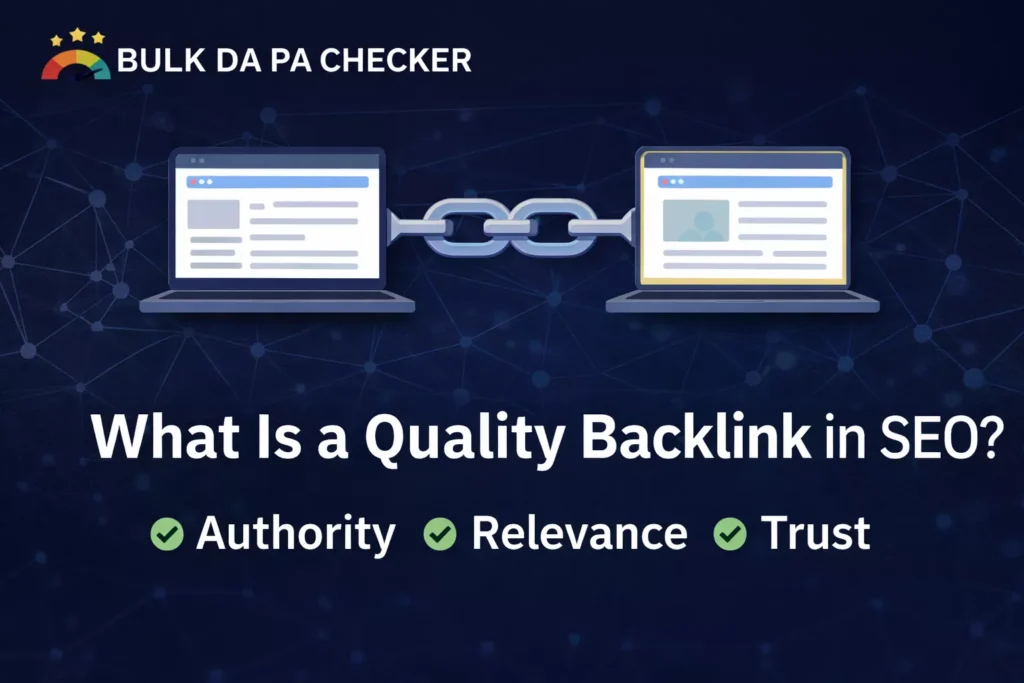
A quality backlink in SEO is a link from a relevant, authoritative, and trustworthy website that points to your page naturally. It passes real ranking value when it comes from a credible source, uses appropriate anchor text, and is contextually placed within useful content. High-quality backlinks improve rankings, traffic, and domain authority.
A backlink becomes high-quality when it checks these boxes:
-
✅ Comes from an authoritative domain
-
✅ Is topically relevant
-
✅ Is placed naturally within content
-
✅ Uses appropriate anchor text
-
✅ Is not part of a spam network
Let’s break these down.
Authority: Why It Matters
Authority refers to the strength and credibility of the linking website. Links from trusted, established sites pass more ranking value than links from low-quality or new domains.
Authority is often measured using:
-
Domain Authority (DA)
-
Domain Rating (DR)
-
Trust Flow (TF)
Although Google does not use DA or DR directly, high-authority domains often have:
-
Strong backlink profiles
-
Real traffic
-
Editorial standards
-
Brand credibility
When evaluating prospects using a dapa checker or bulk dapa checker, authority helps you prioritise valuable opportunities.
But Authority Alone Is Not Enough
A high-DA website in an unrelated niche does not automatically create a quality backlink. That brings us to relevance.
Relevance: The Most Underrated Ranking Signal
Relevance means the linking website and content are closely related to your topic or niche. Topical alignment increases link value and ranking impact.
For example:
-
An SEO blog linking to your SEO tool → Highly relevant
-
A random cooking blog linking to your SEO service → Weak relevance
Google’s algorithm increasingly values contextual relationships.
Types of Relevance:
-
Domain-level relevance – Is the website in your niche?
-
Page-level relevance – Is the specific article related to your topic?
-
Anchor relevance – Does the anchor text match the topic naturally?
Professional SEOs prioritise relevance over raw authority.
Trust: The Hidden Layer of Link Quality
Trust refers to the credibility and legitimacy of the linking site. A trustworthy site has clean backlink patterns, real traffic, and no spam signals.
Signals of a trustworthy site:
-
Balanced TF/CF ratio
-
Low spam score
-
Real organic traffic
-
No link-selling footprints
When using a bulk da pa checker free tool, combine authority metrics with trust evaluation.
What Is a DoFollow Link?
A DoFollow link passes link equity (often called “link juice”) and contributes directly to ranking signals.
These links:
-
Help improve rankings
-
Strengthen domain authority
-
Influence PageRank flow
Most editorial backlinks are DoFollow by default.
What Is a NoFollow Link?
A NoFollow link contains a rel=”nofollow” attribute that tells search engines not to pass link equity directly.
However:
-
NoFollow links still drive traffic
-
They improve link diversity
-
They contribute to a natural backlink profile
Google now treats NoFollow as a “hint,” not a strict directive.
Which Is Better?
Professional answer:
-
You need both.
-
A 100% DoFollow profile looks unnatural.
-
A balanced link profile appears organic.
Anchor Text Types (And How to Optimise Them)
Anchor text is the clickable text of a backlink. Proper anchor text improves topical signals and ranking clarity.
Main Anchor Text Types:
1. Exact Match
Example: quality backlinks in SEO
High risk if overused.
2. Partial Match
Example: guide about quality backlinks
Safer and natural.
3. Branded
Example: BulkDapa
Very safe and natural.
4. Naked URL
Example: https://bulkdapa.site/
Neutral anchor.
5. Generic
Example: click here
Low SEO value but natural.
Anchor Text Best Practice
For SEO professionals:
-
Avoid over-optimisation
-
Maintain anchor diversity
-
Use contextual anchors
When analysing competitor anchors using a da pa bulk checker, look for patterns—not just metrics.
What Makes a Backlink Toxic?
A toxic backlink is a low-quality or spam-driven link that can harm your website’s ranking potential.
Signs of Toxic Backlinks:
-
Links from PBNs (Private Blog Networks)
-
Gambling/adult spam domains
-
Irrelevant foreign-language sites
-
High Spam Score domains
-
Massive exact-match anchor spam
Google’s algorithm is good at ignoring bad links, but excessive toxic links may require disavow.
Should You Disavow Toxic Links?
Only if:
-
You see manual action warnings
-
There is clear negative SEO
-
Spam links are dominating your profile
Most natural low-quality links are ignored automatically.
How Backlinks Affect DA
Backlinks influence Domain Authority because DA is calculated based on backlink quantity and quality.
DA increases when:
-
You gain links from high-authority domains
-
You improve referring domain diversity
-
You reduce spam links
However:
DA is a third-party metric, not a Google ranking factor.
Still, many agencies track DA growth using tools like:
-
bulk da pa checker
-
check da pa bulk
-
bulk dapa checker
These tools help measure relative authority progress.
How Backlinks Impact SEO Rankings (Beyond DA)
Backlinks impact SEO far beyond Domain Authority. They influence ranking power, help Google discover and index pages, strengthen trust signals, and drive targeted referral traffic. High-quality backlinks act as endorsements, signalling to search engines that your content deserves visibility.
Let’s break this down properly.
1. Ranking Power
Stronger links → Higher ability to rank.
Backlinks are essentially votes of confidence. When authoritative websites link to your page, they transfer link equity (often called PageRank value). This improves your page’s competitive strength in search results.
Here’s what actually matters:
-
Referring domain quality – A link from an authoritative, relevant site carries more weight than dozens of low-quality links.
-
Referring domain diversity – 50 links from 50 domains are stronger than 50 links from one domain.
-
Contextual placement – Links embedded naturally inside content pass more value than sidebar or footer links.
-
Topical alignment – Links from pages related to your niche amplify ranking relevance.
In competitive niches, the difference between position #3 and #1 is often link quality — not content length.
Backlinks increase your ability to compete for:
-
High-volume keywords
-
Commercial intent terms
-
Competitive SERPs
Without strong backlinks, even well-written content struggles to break into top positions.
2. Crawling & Indexing
Google discovers pages via links.
Search engines use links to:
-
Discover new pages
-
Understand site structure
-
Prioritise crawling
If your page has no internal or external backlinks, it may:
-
Take longer to index
-
Be crawled less frequently
-
Receive lower crawl priority
High-quality backlinks from frequently crawled sites can:
-
Accelerate indexing
-
Increase crawl frequency
-
Improve content freshness signals
This is especially important for:
-
New websites
-
New landing pages
-
Fresh blog posts
Backlinks act as pathways for search engine bots. The stronger and more authoritative the source, the faster and more reliably your content gets discovered.
3. Trust & Credibility
High-quality links signal authority.
Google’s algorithms evaluate trust signals at scale. When reputable websites link to you, it reinforces:
-
Expertise
-
Authority
-
Trustworthiness
This aligns with Google’s E-E-A-T framework (Experience, Expertise, Authoritativeness, Trust).
Think of backlinks like academic citations:
-
If respected publications reference your work, it increases credibility.
-
If unknown or spammy sources reference you, it weakens perceived trust.
Trust-based signals include:
-
Links from real businesses
-
Links from niche-relevant blogs
-
Editorial mentions
-
Branded anchor mentions
Over time, a clean backlink profile builds domain-level trust, which supports:
-
Core keyword rankings
-
New page ranking speed
-
Overall domain stability
Trust compounds. Spam does not.
4. Referral Traffic
Direct visitors from relevant sites.
Backlinks aren’t just about rankings. They drive real traffic.
A high-quality backlink from a relevant website can:
-
Send targeted visitors
-
Increase engagement
-
Improve brand awareness
-
Generate conversions
For example:
-
A backlink from an SEO blog to your SEO tool can drive highly qualified traffic.
-
A random, unrelated backlink may send zero visitors.
Referral traffic also provides indirect SEO benefits:
-
Increased brand searches
-
Higher engagement signals
-
More natural link acquisition
In many cases, the best backlinks are the ones that bring both:
✔ Ranking value
✔ Real users
The Bigger Picture
Backlinks influence SEO in multiple layers:
-
Algorithmic ranking strength
-
Discovery and crawling
-
Trust evaluation
-
User acquisition
Domain Authority is only a reflection of link profile strength. The real impact of backlinks happens at the algorithmic and behavioural level.
For professionals, this means:
Don’t just measure DA increases.
Measure:
-
Referring to domain growth
-
Link relevance
-
Traffic from backlinks
-
Anchor text distribution
-
Topical authority development
Backlinks are not just metrics.
They are signals of trust, relevance, and competitive strength.
According to large-scale ranking studies by Ahrefs and Backlinko, pages ranking #1 typically have significantly more referring domains than lower-ranking pages.
What a High-Quality Backlink Looks Like (Checklist)
Here’s a simple evaluation checklist:
-
Is the site authoritative?
-
Is it topically relevant?
-
Does it have real traffic?
-
Is the anchor text natural?
-
Is it contextually placed?
-
Is it DoFollow (if editorial)?
-
Is the TF/CF ratio healthy?
If the answer is yes to most of these, it’s likely a quality backlink.
Common Mistakes Professionals Make
-
Chasing high DA without checking relevance
-
Over-optimising anchor text
-
Ignoring traffic metrics
-
Buying links purely based on DR
-
Building too many links too fast
Quality > Quantity. Always.
FAQs
What is a high-quality backlink?
A high-quality backlink comes from a relevant, authoritative, and trustworthy website. It is placed naturally within useful content and uses appropriate anchor text.
Are NoFollow backlinks useless?
No. NoFollow backlinks help create a natural link profile and can drive referral traffic. Google may also treat them as ranking hints.
How do backlinks increase Domain Authority?
Backlinks increase DA by improving a domain’s perceived link strength. More high-quality referring domains generally lead to higher DA scores.
What is a toxic backlink?
A toxic backlink is a spammy or manipulative link from low-quality domains that may harm your SEO performance.
Call to Action
If you manage multiple domains or client projects, manual backlink evaluation is slow and inefficient.
Use a reliable bulk da pa checker to instantly analyse DA, PA, and link metrics at scale.
Read Also: Which SEO Authority Score Should You Trust? DA vs DR vs TF