









You’ve probably heard it a dozen times: “Post more on social media — it helps your Google rankings.” It sounds logical. More shares, more visibility, more traffic, so Google must reward that, right?
Not exactly.
This is one of the most persistent myths in the SEO world, and it keeps beginners chasing the wrong signals while their competitors quietly build the things that actually move the needle. If you’re a blogger or early-stage SEO trying to figure out where to invest your time, this article is going to give you a straight answer — no fluff, no fence-sitting.
By the end, you’ll know exactly what Google has said about social signals, why the “correlation” you keep reading about is misleading, and what you should be doing instead to rank in 2026.
What Are Social Signals in SEO?
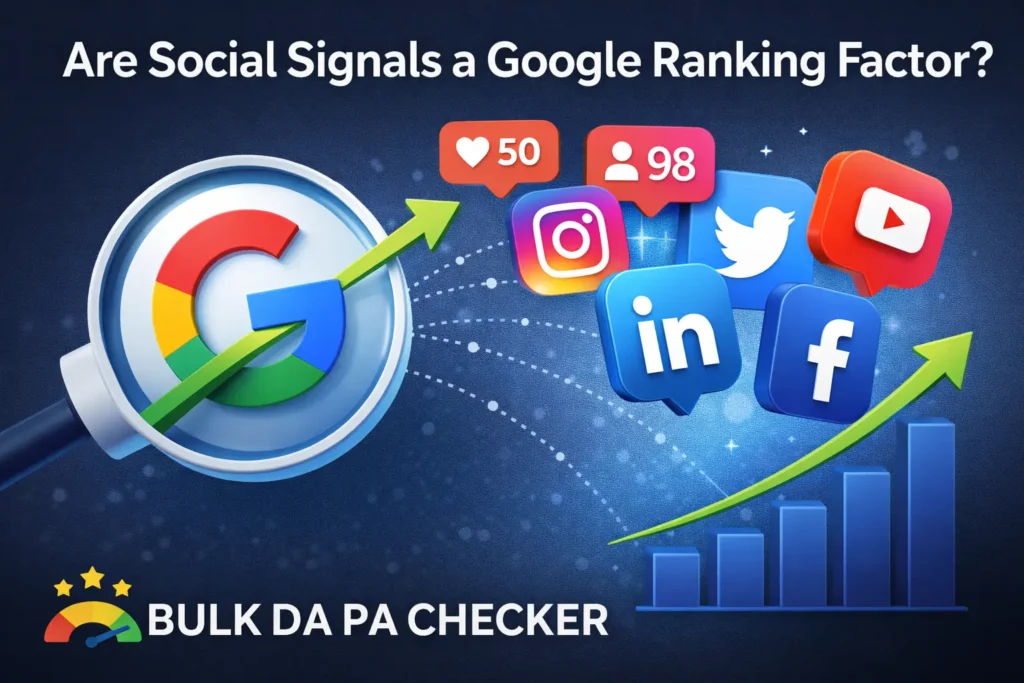
Social signals in SEO refer to the engagement metrics your content receives on social media platforms, things like Facebook shares, Twitter/X likes and retweets, LinkedIn reactions, Pinterest saves, and Instagram engagement. SEOs have long debated whether these signals influence how Google ranks a webpage. The short answer is: they don’t — at least not directly.
Social signals are essentially the digital footprints your content leaves across social platforms. They include:
- Likes, reactions, and upvotes on Facebook, Reddit, and LinkedIn
- Shares and retweets on Twitter/X, Facebook
- Saves and repins on Pinterest
- Comments and mentions across platforms
- Follower counts and social authority scores
The idea was simple: if a lot of people are engaging with your content on social media, it must be valuable — so Google should rank it higher. It made intuitive sense. But SEO isn’t always intuitive.
What Does Google Actually Say About Social Signals?
Google has publicly and repeatedly stated that social signals, such as likes, shares, and followers — are not used as direct ranking factors in its algorithm. Former Google engineer Matt Cutts confirmed this in a widely-cited 2014 video, and Google’s John Mueller has reiterated it multiple times since. Google cannot reliably crawl or verify social media data, which is a big reason it doesn’t use it directly.
Let’s go straight to the source.
Matt Cutts’ 2014 Statement (Still Holds Up)
Back in 2014, Google’s then-head of web spam Matt Cutts released a video explicitly stating that Facebook and Twitter signals are not part of Google’s ranking algorithm. He explained that Google treats social media pages like any other webpage — it can crawl them, but it doesn’t use the social engagement data as a ranking signal.
That was over a decade ago. And nothing has changed.
John Mueller’s Repeated Clarifications
Since Cutts, John Mueller (Google’s Search Advocate) has addressed this topic multiple times in Google Search Central office hours and across social media. His stance has been unwavering: Google doesn’t use social signals as a ranking factor. No asterisks. No exceptions.
Why Can’t Google Just Use Social Data?
Here’s the technical reality most people overlook — and it’s just as relevant in 2026 as it was in 2014:
- Access is unreliable. Social platforms frequently block or limit Googlebot from crawling their content.
- Data is manipulable. Likes and followers can be bought in bulk for a few dollars. Google knows this and using such signals would make its algorithm trivially gameable.
- Privacy restrictions. A large chunk of social content is behind login walls or restricted to followers only.
According to Google’s official Search Central documentation, rankings are based on relevance, quality, and authority signals that Google can consistently verify, social metrics don’t make that list.
The Correlation vs. Causation Trap
Many studies show that highly shared content tends to rank well on Google, but this is correlation, not causation. Content that gets a lot of social shares is usually high-quality, well-promoted content that also earns backlinks and traffic. It’s those backlinks and engagement signals — not the shares themselves that actually influence Google rankings. Don’t mistake the symptom for the cure.
This is where most bloggers get misled, even in 2026.
You’ll find studies and blog posts pointing out that content with thousands of shares tends to rank on page one. And that’s true. But here’s what those posts usually fail to mention:
That same content also tends to:
- Earn natural backlinks from other websites
- Drive significant referral traffic
- Get brand mentions across the web
- Generate longer on-site engagement signals
So when that content ranks well, is it because of the shares or because of everything else those shares triggered? Almost always, it’s the latter.
Think of it this way: wealthy people tend to drive nice cars. But buying a nice car won’t make you wealthy. Confusing correlation with causation in SEO leads you to optimize for the wrong things — and waste months of effort in the process.
How Social Signals Indirectly Help Your SEO
While social signals aren’t direct ranking factors, they can indirectly benefit your SEO in meaningful ways. Content that performs well on social media often attracts more backlinks, earns more brand searches, and drives traffic that improves user engagement metrics. These downstream effects, not the social activity itself are what potentially influence your Google rankings.
Here’s where it gets nuanced, and where the smart SEO play actually lives in 2026.
1. Social Media Drives Traffic That Google Can Measure
When a blog post goes viral on Twitter/X or gets shared in a Facebook group, it drives real human visitors to your site. Google pays attention to how users interact with your content — time on page, bounce rate, return visits. High-quality traffic from social can strengthen these engagement signals.
2. Shares Lead to Backlinks
This is the big one. When your content gets in front of journalists, bloggers, and content creators via social media, some of them will link to it. Backlinks remain one of Google’s top-confirmed ranking factors — and social amplification is one of the most effective ways to earn them organically.
3. Brand Searches Signal Authority
If people see your brand repeatedly on social media and then search for it on Google, that increases your branded search volume. There’s a strong argument — backed by years of anecdotal evidence from seasoned SEOs — that Google uses branded search as a trust and authority signal.
4. Faster Content Discovery
Google’s crawlers often discover new content faster when it gets shared on platforms like Twitter/X. This doesn’t affect rankings directly, but faster indexing means faster opportunity to rank — especially in competitive niches where timing matters.
You can learn more about maximizing the signals that actually impact rankings over at bulkdapa.site, where we break down domain authority metrics and SEO tools built for bloggers and small site owners.
What Actually Moves the Needle in 2026
In 2026, the ranking factors Google consistently rewards are high-quality backlinks, strong on-page SEO, excellent content that matches search intent, fast page speed, mobile usability, and positive user engagement signals. Social media can support these indirectly — but spending hours chasing likes and shares instead of building links and optimizing content is a losing strategy.
Let’s be direct: if you’re a blogger spending three hours crafting Instagram carousels hoping it’ll boost your Google rankings, stop. Here’s where your time is better spent:
✅ Earn Real Backlinks
Guest post, create linkable assets (original research, tools, data), and do digital PR. One solid backlink from a relevant DA 50+ site beats 10,000 Facebook shares — every single time.
✅ Nail Your On-Page SEO
Title tags, meta descriptions, header structure, internal linking, and keyword placement still matter enormously. Use a tool like BulkDAPAChecker to audit your domain authority and benchmark against competitors before you publish another word.
✅ Create Content That Matches Search Intent
Google’s Helpful Content system rewards pages that fully satisfy what the searcher actually wants. Write for humans, structure for Google — that balance is the whole game in 2026.
✅ Improve Core Web Vitals
Page speed, interactivity, and visual stability are confirmed ranking signals. Run your site through Google PageSpeed Insights regularly — slow sites lose rankings quietly and consistently.
✅ Build Topical Authority
Instead of posting on six social platforms daily, publish 10 deeply researched articles on your core topic. Topical depth signals expertise to Google — and earns the kind of trust that actually converts readers into loyal audiences.
Common Mistakes Beginners Make Around Social Signals
A lot of new bloggers fall into these traps in 2026 — don’t be one of them:
- Buying social signals, thinking it’ll improve rankings. It won’t — and it wastes your budget on something Google ignores.
- Ignoring social media entirely because “it doesn’t affect SEO.” It indirectly does — use it strategically to amplify content and earn links.
- Treating social metrics as SEO KPIs. Track rankings, organic traffic, and backlinks — not likes and follower counts.
- Focusing on follower count over content quality. A small engaged audience that shares and links to your work is worth more than 50,000 passive followers who never click.
FAQs
Does sharing my blog on social media help SEO?
Not directly. But it can help indirectly by driving traffic, building brand awareness, and increasing the chance that someone links to your content.
Do Facebook likes affect Google rankings?
No. Google has confirmed it does not use Facebook engagement data as a ranking signal.
Does Twitter/X activity help rankings?
Not directly. However, Twitter/X content is indexed by Google, and viral tweets can drive traffic and link discovery — both of which can have downstream SEO benefits.
Are social signals worth investing in for a new blog in 2026?
Focus on SEO fundamentals first — keyword research, on-page optimization, and link building. Use social media as a content distribution channel, not a ranking strategy.
What social platform is most useful for SEO indirectly?
Twitter/X and LinkedIn tend to drive the most link-earning opportunities because they’re used heavily by bloggers, journalists, and content creators — the exact people most likely to link to your content.
The Bottom Line
Social signals are not a direct Google ranking factor — and they almost certainly won’t become one anytime soon, given the data reliability and manipulation issues that have existed for over a decade. Google has said it clearly. Repeatedly. Across multiple spokespeople and multiple years.
But that doesn’t mean social media is useless for SEO. Used strategically, to distribute content, earn backlinks, build brand awareness, and drive real traffic, social platforms can support your SEO efforts in ways that genuinely compound over time.
The mistake is treating social engagement as a shortcut to rankings. There are no shortcuts in 2026. What works is the same as what’s always worked: quality content, authoritative backlinks, solid technical SEO, and a genuine understanding of search intent.
Want to know where your site actually stands? Use the free domain authority checker at BulkDAPAChecker to audit your DA, PA, and spam score and get a clearer picture of what’s really driving (or quietly holding back) your rankings.