




Your website could be doing everything right, great content, solid on-page SEO, consistent Google Business Profile updates, and still lose rankings. If that sounds familiar, toxic backlinks may be quietly working against you.
For local business owners, this is a particularly painful problem. You don’t have a dedicated SEO team monitoring your backlink profile daily. You’re focused on running your business. And in that gap, spammy websites, negative SEO attacks, and old link-building mistakes can accumulate into a real threat against your online visibility.
Domain Authority isn’t just a vanity metric. It’s a strong indicator of how much trust Google places in your website — and toxic backlinks erode that trust directly. In this guide, you’ll learn exactly what toxic backlinks are, how they damage your DA and rankings, and the precise steps to clean up your backlink profile before the damage becomes permanent.
What Are Toxic Backlinks?
Quick Answer: Toxic backlinks are inbound links from low-quality, spammy, or manipulative websites that point to your domain. They can come from link farms, adult or gambling sites, private blog networks (PBNs), hacked websites, or sites with extremely low domain authority and high spam scores. Google’s algorithm is designed to detect and penalize sites that appear to be manipulating rankings through unnatural link patterns — and toxic backlinks are a primary trigger.
Not all backlinks are created equal. A link from a respected industry publication is a vote of confidence. A link from a spam directory or a hacked foreign website is a liability.
Common Sources of Toxic Backlinks:
- Link farms — networks of low-quality sites created solely to sell or exchange links
- Private Blog Networks (PBNs) — artificially created blogs used to manipulate rankings
- Irrelevant foreign directories — low-authority directories with no topical relevance to your business
- Hacked or compromised websites — sites that have been taken over and repurposed for spam
- Adult, gambling, or pharmaceutical spam sites — especially damaging for local business credibility
- Over-optimized anchor text links — unnatural patterns of exact-match keyword anchors pointing to your site
- Paid link schemes — links purchased in violation of Google’s Webmaster Guidelines
For a local plumber, dentist, or retail store, even a handful of these links in your backlink profile can raise red flags with Google’s algorithm, regardless of how clean the rest of your SEO is.
How Toxic Backlinks Damage Your Domain Authority
Quick Answer: Toxic backlinks damage Domain Authority by increasing your site’s spam score and reducing the overall quality signals of your backlink profile. Tools like Moz calculate DA based on the strength and quality of your inbound links, the more toxic links you accumulate, the lower your DA score trends. A dropping DA correlates strongly with reduced ranking potential across all your target keywords, making it harder for local customers to find your business online.
Domain Authority (developed by Moz) is a 1–100 score that predicts how well a website will rank in search engines. It’s calculated largely based on the quality and quantity of inbound links. When toxic links enter your profile, they drag that score down, and the effects are compounding.
The Damage Happens in Three Layers:
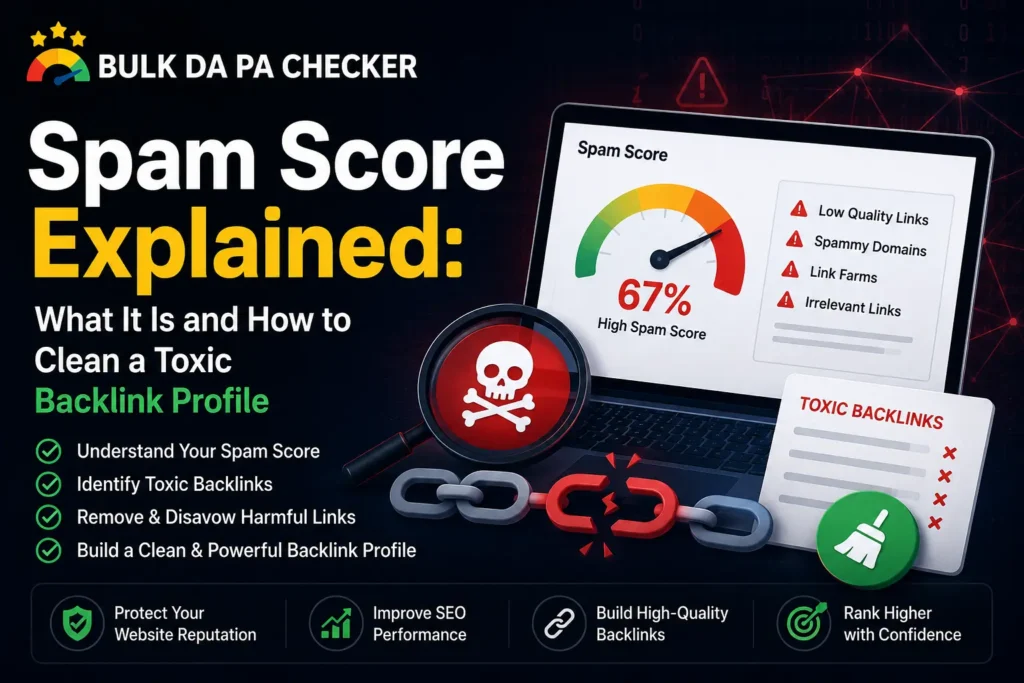
Layer 1: Spam Score Increases
Your spam score is a metric that reflects the likelihood of your site being penalized, rising as toxic links accumulate. A high spam score signals to both Moz’s algorithm and Google’s systems that your link profile is unnatural or manipulative.
Layer 2: Link Equity Gets Diluted
Every toxic link dilutes the overall authority of your backlink profile. Even if you have strong links from reputable sources, a growing cluster of spammy links reduces the net quality signal Google receives about your domain.
Layer 3: Google Trust Erodes
Google’s PageRank and broader ranking systems evaluate link quality at scale. Sites with consistently poor backlink neighborhoods, meaning the types of sites linking to them, receive less trust, which directly translates to lower rankings in local and organic search results.
Use the free domain authority checker to see your current DA and spam score side by side — it takes under a minute and gives you an immediate picture of where your domain stands.
Real-World Impact: Penalties, Ranking Drops & Lost Revenue
Quick Answer: The real-world impact of toxic backlinks ranges from gradual ranking erosion to sudden Google manual penalties. A manual penalty can completely remove your site from search results, devastating for any local business that depends on Google for customer discovery. Even without a formal penalty, algorithmic filtering from Google’s Penguin system can suppress your rankings for months, resulting in lost traffic, fewer inquiries, and direct revenue loss.
This isn’t theoretical. Here’s what toxic backlinks actually cost local businesses:
Google Penguin Algorithm Penalties
Google’s Penguin algorithm (now integrated into the core algorithm and running in real time) specifically targets unnatural link patterns. If your backlink profile triggers Penguin, your rankings can drop suddenly and significantly — often overnight.
Manual Actions From Google’s Web Spam Team
In more severe cases, Google’s human reviewers issue manual actions — formal penalties that can partially or fully remove your site from search results. According to Google’s Search Central documentation, manual actions for unnatural links are among the most common penalties issued to websites.
The Local Business Cost
For a local business, losing page-one rankings for your core service keywords “dentist in [city]”, “plumber near me”, “best restaurant in [town]” can mean:
- A measurable drop in phone calls and form submissions
- Loss of Google Maps pack visibility
- Competitors filling the space you previously occupied
- Months of recovery work to regain lost ground
The longer toxic links go unaddressed, the more compounding damage they cause.
How to Audit Your Backlink Profile
Quick Answer: To audit your backlink profile, use a combination of Google Search Console and a dedicated SEO tool like Ahrefs, Semrush, or BulkDAPAChecker. Export your full list of inbound links and look for patterns: low DA linking domains, high spam scores, irrelevant foreign sites, over-optimized anchor texts, and sudden spikes in new links. A clean audit gives you the data you need to take targeted action.
Here’s a step-by-step audit process any local business owner or their SEO provider can follow:
Step 1: Export Your Full Backlink Profile
Use Google Search Console (free) to download all links pointing to your site. For deeper data, supplement with Ahrefs or Semrush.
Step 2: Check Domain Authority & Spam Scores
For each linking domain, check the DA and spam score. Any domain with a spam score above 30% warrants closer inspection. Run bulk checks quickly using the free SEO tools at BulkDapa, where you can check multiple domains at once rather than one by one.
Step 3: Flag Toxic Links
Look for these red flags:
- DA below 10 with no clear relevance to your industry
- Spam score above 30–40%
- Sites in unrelated niches (adult, gambling, pharma) linking to your local business
- Foreign-language sites with no logical connection to your content
- Links using exact-match anchor text unnaturally (e.g., “best plumber NYC” repeated across dozens of low-quality sites)
Step 4: Categorize by Risk Level
Not every low-quality link needs to be disavowed. Prioritize:
- High risk: Links from known spam networks, PBNs, or penalized domains
- Medium risk: Links from irrelevant low-DA sites
- Low risk: Links from low-DA but legitimate sources (small blogs, minor directories)
Step 5: Document Everything
Keep a spreadsheet of flagged links with their URL, DA, spam score, anchor text, and risk category. You’ll need this for the removal and disavow process.
How to Remove or Disavow Toxic Backlinks
Quick Answer: To remove toxic backlinks, first contact the linking website directly and request removal. If that fails which it often does use Google’s Disavow Tool to tell Google to ignore those links when evaluating your site. The disavow file should be submitted through Google Search Console and formatted correctly as a plain text file listing the domains or URLs you want Google to discount.
Option 1: Manual Outreach (Try First)
Contact the webmaster of the linking site and request link removal. Keep the email professional and brief. Response rates are low, typically 10–20%, but it’s worth attempting before escalating.
Option 2: Google’s Disavow Tool (Primary Solution)
For links you can’t get removed manually:
- Go to Google’s Disavow Tool via Search Console
- Create a plain .txt file listing the domains to disavow (format:
domain:example.com) - Upload the file and submit
- Monitor your backlink profile and rankings over the following 4–8 weeks
Important: The Disavow Tool is powerful but should be used carefully. Disavowing legitimate links by mistake can hurt your rankings. If you’re unsure, consult an SEO professional before submitting.
Option 3: Ongoing Monitoring
Removing toxic links is not a one-time task. Set up automated backlink alerts in Ahrefs or Semrush to notify you when new links are acquired — so you can catch toxic links early before they compound.
How to Protect Your Site From Toxic Backlinks Going Forward
Quick Answer: To protect your site from toxic backlinks, conduct quarterly backlink audits, set up automated link monitoring alerts, avoid any link-building tactics that violate Google’s guidelines, and focus on earning links naturally through quality content and local citations. For local businesses, building genuine relationships with local publications, industry associations, and community organizations is the most sustainable and penalty-proof link-building strategy available.
Prevention is significantly less painful than recovery. Here’s how to stay protected:
- Audit quarterly — Schedule a backlink audit every 90 days, not just when you suspect a problem
- Monitor new links in real time — Use Ahrefs alerts or Google Search Console notifications
- Avoid black-hat link building — Never purchase links, participate in link exchanges, or use PBN services
- Build local citations properly — Submit your business to legitimate, high-authority local directories (Yelp, BBB, local chamber of commerce sites)
- Create linkable local content — Local guides, community resources, and data-driven posts earn natural links from local press and bloggers
- Audit your SEO agency — If you’re outsourcing SEO, ask specifically what link-building tactics they use. Some agencies still use practices that put your domain at risk
FAQs
Can toxic backlinks destroy my local business rankings?
Yes — particularly if they trigger Google’s Penguin algorithm or result in a manual penalty. Even without a formal penalty, a high spam score from toxic links can suppress your rankings over time.
How do I know if my site has toxic backlinks?
Run a backlink audit using Google Search Console combined with a spam score checker. The free tools at BulkDAPAChecker let you quickly check DA and spam scores across your linking domains to identify problem areas fast.
Does disavowing links always improve rankings?
Not immediately — and not always dramatically. Disavowing removes the negative signal, but recovering rankings depends on many factors including how long the toxic links have been active and whether a manual penalty was involved. Recovery typically takes 4–12 weeks.
Can competitors send toxic links to my site on purpose?
Yes, this is called negative SEO. While Google has become better at ignoring obvious spam link attacks, monitoring your backlink profile regularly protects you from this risk and lets you disavow malicious links quickly.
What’s a safe spam score range for my domain?
Generally, a spam score below 10% is considered healthy. Scores between 10–30% warrant monitoring. Above 30%, a thorough backlink audit and cleanup is strongly recommended.
The Bottom Line
Toxic backlinks are one of the most underestimated threats to a local business’s online visibility. They work quietly, degrading your Domain Authority, increasing your spam score, and eroding Google’s trust in your domain, often long before you notice a ranking drop.
The good news is that with a structured audit process, targeted outreach, and Google’s Disavow Tool, the damage is reversible. But the earlier you catch it, the easier the recovery.
Don’t wait for a ranking drop to tell you something is wrong. Start with your baseline — check your domain authority and spam score right now using the free domain authority checker. It takes 60 seconds and gives you the data you need to make informed decisions about your backlink profile.