









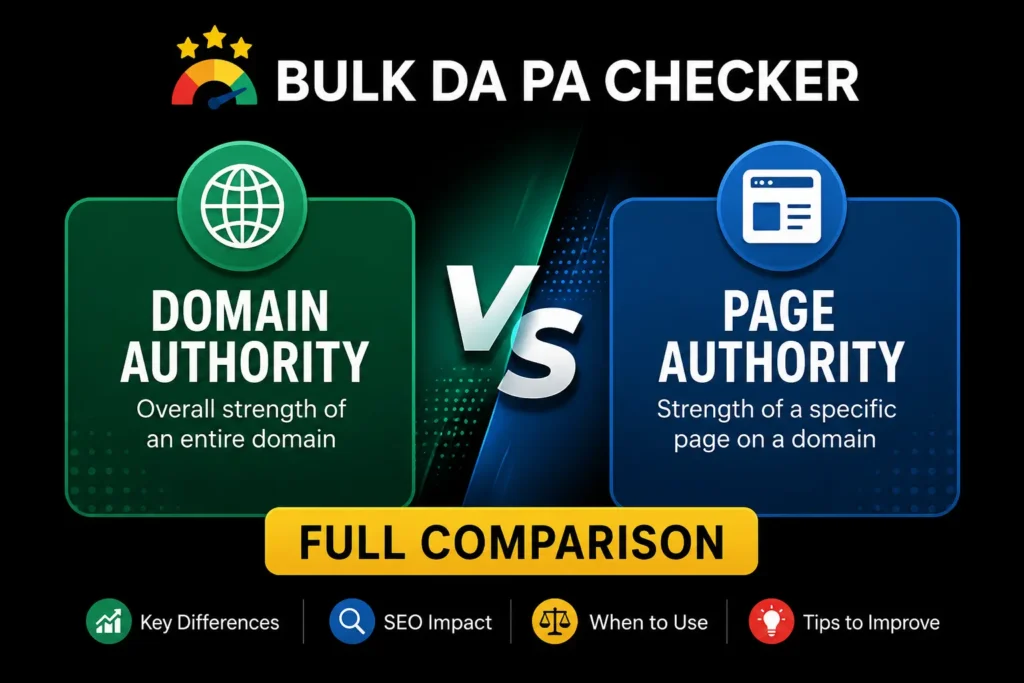
Domain Authority vs Page Authority: Learn the key differences between DA and PA, how each metric affects SEO rankings, when to use them, and practical tips to improve your website’s authority.
Domain Authority (DA) measures the ranking strength of an entire website domain, while Page Authority (PA) measures the ranking strength of a single webpage URL. Both are Moz metrics scored from 1 to 100. Use DA when evaluating a website as a whole, and PA when you need to know the strength of a specific page for link building or competitive analysis.
What Is the Core Difference Between DA and PA?
Domain Authority (DA) scores an entire website based on all the backlinks pointing to any page on that domain. Page Authority (PA) scores a single URL based on the backlinks pointing specifically to that one page. DA tells you about the domain’s overall ranking potential. PA tells you about one specific page’s ranking potential. Both are Moz metrics scored from 1 to 100 using similar machine learning models.
Think of it this way. DA is the reputation of the entire company. PA is the reputation of one specific employee at that company. A company can have a strong overall reputation while certain employees are relatively unknown, and a well-known employee can work at a company with a modest overall reputation.
According to Moz, both DA and PA are calculated using the same underlying machine learning model. The primary difference is scope: DA pulls from all links across the entire domain, while PA only counts links pointing to that specific URL.
| Feature | Domain Authority (DA) | Page Authority (PA) |
|---|---|---|
| What it measures | Entire website domain | Single webpage URL |
| Based on | All backlinks across the domain | Backlinks to that specific URL only |
| Score range | 1 to 100 | 1 to 100 |
| Best used for | Evaluating link prospects, competitor sites | Identifying strong pages to target or build |
| Changes when | Domain gains or loses backlinks | Specific page gains or loses backlinks |
| Useful for | Link outreach qualification | Page-level link building decisions |
When Should You Use Domain Authority?
Use domain authority when you need to evaluate a website as a whole. DA is the right metric for qualifying link building prospects before outreach, comparing your site against competitors at the domain level, identifying which websites carry enough authority to be worth pursuing for guest posts or partnerships, and filtering out low-quality or spammy sites from your link lists. Most link builders use DA 30 or above as a minimum threshold.
In my link building work, DA is the first filter I apply to any prospect list. If a site has DA below 20 and is not in a highly relevant niche, it usually goes straight to the bottom of the priority list. Time is limited and you want links from sites that carry real weight.
From experience: A blogger I worked with was spending hours reaching out to sites manually, checking each one individually on Moz. They had a list of 200 prospects and were processing maybe 15 per hour. I introduced them to the Bulk DA PA Checker at BulkDapa.site. They ran all 200 domains in under two minutes, filtered out every site below DA 25, and cut their list to 80 genuinely strong prospects. Their outreach reply rate jumped from 4% to 11% because they were only contacting authoritative, maintained sites.
DA is also the right metric when you are assessing your own site’s progress over time. Watching your domain-level DA trend upward over 6 to 12 months tells you your overall link building strategy is working.
When Should You Use Page Authority?
Use page authority when making decisions about individual URLs rather than whole websites. PA is the right metric for finding the strongest page on a site to request a backlink from, comparing two pages on the same domain, deciding which of your own pages to prioritize for internal linking, and identifying which competitor pages are most authoritative so you can replicate their backlink strategy. PA is always lower than or equal to the domain’s DA.
Here is a practical example. You want a backlink from a site with DA 45. You find two pages where a link would be natural: a blog post with PA 28 and a resource page with PA 41. The resource page will pass more link equity. PA tells you where to focus your request.
PA is also critical when you are doing broken link building. You want to find broken links on high-PA pages, not just high-DA sites. A broken link on a page with PA 50 is worth far more effort than fixing one on a page with PA 12, even if both are on the same high-DA domain.
Research from Ahrefs shows that 43.7% of top-ranking pages have reciprocal links and that backlinks to individual pages directly influence that page’s ability to rank. This is exactly why PA matters for page-level decisions.
Can DA and PA Be Very Different on the Same Site?
Yes, DA and PA can differ significantly on the same website, and this is completely normal. A website’s homepage often has the highest PA because it receives the most internal and external links. Blog posts, product pages, and inner pages typically have much lower PA than the domain’s overall DA. It is common to see a site with DA 50 where most inner pages have PA in the 20 to 35 range.
The homepage almost always has the highest PA on any website because it receives the most links, both internal and external. Every internal navigation menu links to the homepage. Most external backlinks point to the homepage. This concentrates link equity at the root URL.
When I audit client sites, I always check the PA of their most important pages, not just the overall DA. A site can have a strong DA of 40 while its key product or service pages sit at PA 15. That gap tells me internal linking is weak and those pages are not getting the link equity they deserve.
How to Check Both DA and PA at Once
The fastest way to check both Domain Authority and Page Authority at once is to use the Bulk DA PA Checker at BulkDapa.site. Enter up to 50 domains or page URLs at once and get DA, PA, Spam Score, Inbound Links, and Outbound Links for every entry in seconds. You can mix full domains and specific page URLs in the same check, making it ideal for both domain-level and page-level analysis in a single session.
Most SEOs do not realise you can check individual page URLs, not just root domains, in a bulk DA PA checker. Enter bulkdapa.site/blog/ instead of just bulkdapa.site and you get that specific page’s PA score alongside its domain’s DA.
This is especially useful during link prospecting. Build a list that mixes root domains for DA screening and specific page URLs for PA checking, then run the whole list at once through our Bulk DA PA Checker. You get a complete picture of both site-level and page-level authority in one pass.
From experience: An SEO agency I consulted for was running separate DA and PA checks using different tools and processes. They were spending over 3 hours per client audit just gathering authority metrics. After consolidating to the free SEO tools on BulkDapa, including the bulk checker and broken link checker, they cut audit preparation time by 68% and were able to take on 4 additional clients per month without adding headcount.
Frequently Asked Questions
Q: Is Page Authority more important than Domain Authority for ranking?
A: Neither is directly a Google ranking factor. Both are Moz metrics that correlate with ranking ability. For understanding how a specific page will rank, PA is the more relevant metric because it reflects the link strength of that exact URL. For understanding a website’s overall competitive standing, DA is more useful. In practice, both metrics together give you the most complete picture of a site’s authority.
Q: Why is my homepage PA lower than my DA?
A: It should not be. Your homepage typically has the highest PA on your site because it receives the most links. If your homepage PA is significantly lower than your DA, it may indicate that Moz’s index has not fully crawled your site recently, or that your homepage URL has a canonicalization issue. Check that your homepage resolves consistently to one URL format, whether www or non-www, and with or without a trailing slash.
Q: How do I improve Page Authority on a specific page?
A: Build backlinks directly to that specific page URL, not just to your homepage. Also strengthen internal linking by adding links to that page from other high-PA pages on your site. Every high-quality internal link passes some link equity to the target page. Guest posts, digital PR placements, and broken link building targeted at getting links to that specific URL are the most direct way to raise its PA.
Q: Can I check Page Authority for free?
A: Yes. The Bulk DA PA Checker at BulkDapa.site is completely free and lets you check up to 50 URLs at once. Enter full page URLs rather than just domain names and you will get the PA for each specific page alongside DA, Spam Score, and backlink counts. No account or subscription is required.
Q: What is a good Page Authority score?
A: Like DA, PA is relative to what you are competing against. For most niche blog posts and inner pages, a PA of 20 to 40 is solid. High-authority editorial pages on major publications can reach PA 60 to 80. The most useful benchmark is to check the PA of the pages currently ranking on page 1 for your target keyword. That tells you exactly what PA level you need to compete for that specific query.
Use Both Metrics Together for Better SEO Decisions
DA and PA are not competitors. They are complementary signals that answer different questions. Use DA when you need to evaluate a website. Use PA when you need to evaluate a page. Use both when you are building a complete picture of a link prospect or planning your own site’s internal linking strategy.
Start by checking both for your own site and your top competitors using the Bulk DA PA Checker. It is free, handles 50 domains or URLs at once, and takes seconds. The data will immediately show you where authority gaps exist and where your link building efforts should focus.
For more practical SEO guides written from real agency experience, visit our SEO blog. If you want hands-on help applying these metrics to your specific site, the expert SEO consultant service on BulkDapa is available free for an initial consultation.