









Broken links and redirect chains get treated as the same technical SEO problem in a lot of audits, but they damage a site in different ways and need different fixes. Confusing the two often leads to wasted effort patching the wrong issue while the actual cause of a crawl or ranking problem stays untouched.
What a Broken Link Actually Does to a Page
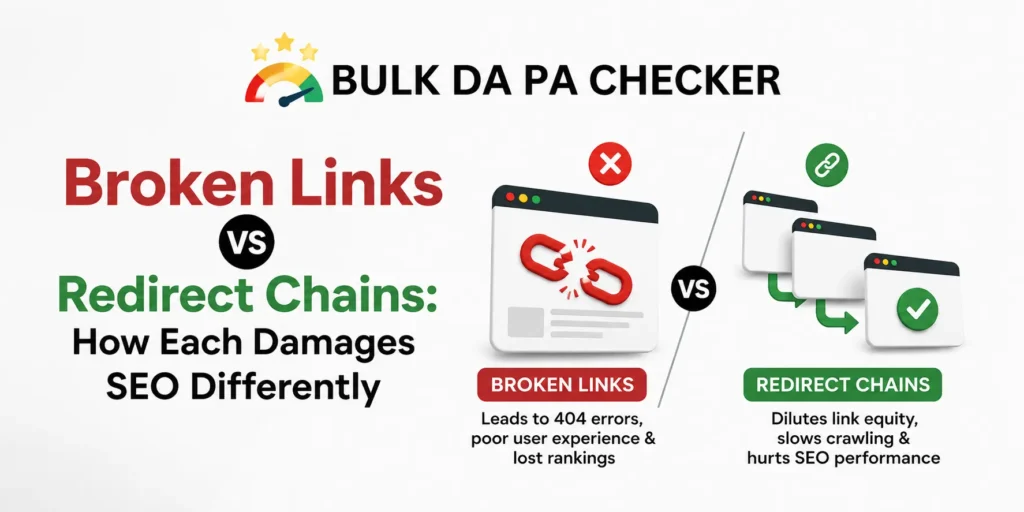
A broken link points to a URL that returns an error, most commonly a 404, providing zero value to whoever clicks it and zero authority transfer if it was a backlink. Broken internal links also waste crawl budget, since Googlebot still requests the dead URL before discovering it leads nowhere.
For visitors, a broken link is a dead end. For search engines, it is a small trust signal problem, especially when broken links accumulate across many pages on the same site.
What a Redirect Chain Actually Does
A redirect chain happens when URL A redirects to URL B, which then redirects to URL C, instead of A redirecting directly to the final destination. Each extra hop adds load time and a small amount of link equity loss, and very long chains can eventually cause crawlers to stop following them entirely.
Unlike a broken link, a redirect chain technically still works, the visitor does eventually land on a real page. The damage is in efficiency, not in a dead end.
How Redirect Chains Usually Form
Redirect chains build up over repeated migrations, where each new redesign adds another redirect on top of old ones instead of updating the original redirect to point straight to the current URL. A site that has changed CMS or URL structure multiple times often has chains nobody intentionally created.
From experience, the longest chain I have personally found during a client audit was five hops deep, the result of three separate website redesigns over six years where each developer added a new redirect layer instead of cleaning up the one before it.
- Site redesigns that redirect old URLs to a new pattern, repeated more than once
- Plugin-based redirects layered on top of server-level redirects
- Migrating CMS platforms without consolidating prior redirect rules
Why Both Issues Quietly Damage SEO
Both broken links and redirect chains interfere with crawl efficiency and link equity transfer, just through different mechanisms. Backlinks remain one of Google’s top three ranking factors, and either issue can dilute the value of those backlinks before they ever reach the page they were meant to support.
From experience, I have seen sites recover noticeable ranking improvement on key pages simply from flattening a chain of three or four redirects down to one direct hop, with no other changes made at the same time. Domain Authority, built largely on backlink signals, often nudges upward after this kind of cleanup since previously diluted link equity finally reaches the intended page.
Finding and Fixing Both at Once
A full link audit should check internal and external links for 404 errors and trace every redirect to its final destination in one pass. Fixing broken links means correcting the destination or removing the link, while fixing redirect chains means pointing the original URL directly at the final live page.
Our Bulk Broken Link Checker flags dead links across a site in bulk, which is the first step before consolidating any redirect chains you find layered behind them.
55.24% of pages on the web have zero backlinks pointing to them according to Ahrefs, and on the pages that do have backlinks, a broken destination or a long redirect chain is one of the most common reasons that earned link equity never actually reaches the page it was meant to help.
How Many Redirect Hops Is Too Many?
A single redirect hop is generally fine and has minimal impact. Two hops still work but start to add measurable delay. Anything beyond three hops should be flattened, since the combination of slower load time and diminishing link equity transfer becomes noticeable at that point.
| Hops | Impact |
|---|---|
| 1 | Minimal, generally acceptable |
| 2 | Slight delay, still workable |
| 3+ | Should be flattened to a direct redirect |
Frequently Asked Questions
Do redirect chains hurt rankings as much as broken links?
They are generally less damaging since the page still resolves, but long chains add real performance and crawl efficiency costs worth fixing.
Should every redirect chain be flattened to a single hop?
Ideally yes, pointing the original URL directly at the final destination is always the cleanest, most efficient setup.
Can a broken link become part of a redirect chain?
Yes, if a chain’s final hop points to a now-deleted page, the entire chain effectively becomes a broken link at the end.
How do I find redirect chains on my site?
Crawling tools that trace each URL’s full redirect path can identify chains, showing every hop between the original and final URL.
Is it worth fixing redirect chains on low-traffic pages?
It is lower priority than high-traffic pages, but worth including in a periodic site-wide cleanup since chains tend to accumulate over time.
Audit Your Links Before They Compound
Our Bulk Broken Link Checker finds broken links across your site in one pass, the natural first step before tracing redirect chains. For ongoing authority tracking, our Bulk DA PA Checker monitors the impact of these fixes over time, and our SEO blog covers more technical SEO cleanup guides like this one.