








De nombreux propriétaires de petits sites web pensent que les politiques de confidentialité ne concernent que les grandes entreprises technologiques qui traitent des données sensibles. Cette idée est dépassée. Plusieurs lois majeures sur la protection des données s'appliquent désormais à presque tous les sites proposant des outils d'analyse, des formulaires de commentaires ou des scripts publicitaires, quelle que soit la taille de l'entreprise qui les gère.
Règle générale : si vous collectez des données, vous en aurez probablement besoin d'une
La plupart des lois sur la protection des données s'appliquent dès qu'un site collecte des données personnelles, y compris les adresses IP collectées automatiquement par les outils d'analyse. De ce fait, une politique de confidentialité est pratiquement obligatoire pour presque tous les sites web modernes, même un simple blog sans formulaire de contact, dès lors qu'un script de suivi est ajouté.
Ce guide fournit des informations générales pour vous aider à comprendre le contexte juridique, mais ne constitue pas un avis juridique adapté à votre situation particulière. La législation évolue, son application varie, et seul un avocat qualifié connaissant votre public et votre juridiction pourra vous conseiller définitivement sur la conformité.
Union européenne : RGPD
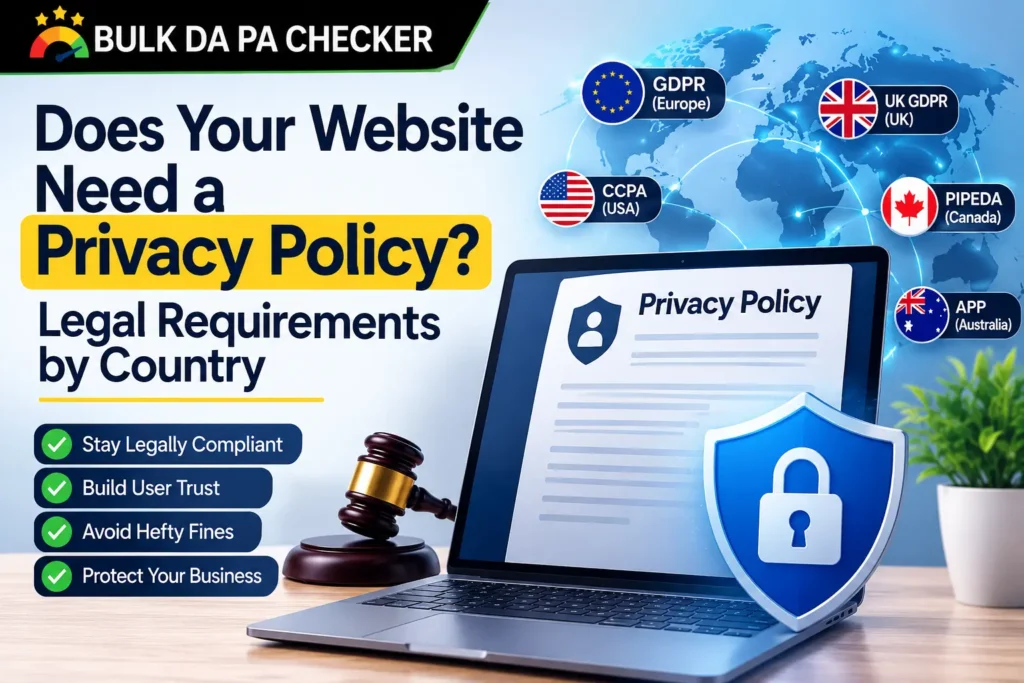
Le Règlement général sur la protection des données (RGPD) exige une politique de confidentialité pour tout site traitant des données personnelles de personnes résidant dans l'UE, quel que soit le lieu d'hébergement ou d'enregistrement du site. Il exige également des mécanismes de consentement clairs pour les cookies non essentiels et les outils de suivi avant leur chargement.
Le RGPD s'applique en fonction des données traitées, et non du lieu d'établissement de l'entreprise ; c'est pourquoi les sites situés hors d'Europe et ayant des visiteurs européens doivent également s'y conformer.
États-Unis : un patchwork de lois étatiques
Aux États-Unis, il n'existe pas de loi fédérale unique sur la protection de la vie privée équivalente au RGPD. En effet, chaque État, notamment la Californie, la Virginie et le Colorado, a adopté sa propre législation en la matière, avec des seuils et des exigences différents, créant ainsi un système disparate qui dépend fortement du lieu de résidence des visiteurs.
La loi californienne est généralement considérée comme la plus stricte et la plus influente, souvent utilisée comme référence de facto par les sites qui souhaitent une politique unique couvrant la majeure partie du trafic américain sans avoir à suivre séparément les règles spécifiques de chaque État.
D'après mon expérience, les sites de petites entreprises avec lesquels j'ai travaillé adoptent généralement une politique de confidentialité conforme aux exigences les plus strictes des États américains plutôt que d'essayer de maintenir des versions distinctes par État, tout simplement parce qu'il est beaucoup plus facile de gérer un seul document que plusieurs.
Canada, Royaume-Uni et autres juridictions communes
La LPRPDE du Canada, la loi britannique sur la protection des données inspirée du RGPD et des cadres juridiques similaires en Australie et au Brésil partagent tous le même principe fondamental : la divulgation des données collectées et de leur utilisation. Si les exigences de formulation varient, l’exigence de transparence demeure la même.
91 % des pages ne reçoivent aucun trafic organique de Google, selon AhrefsEt bien que cette statistique concerne le contenu et les liens entrants plutôt que les pages juridiques directement, les sites qui négligent les signaux de confiance de base comme une politique de confidentialité sont souvent confrontés au même type de déficit de crédibilité que les moteurs de recherche et les réseaux publicitaires pénalisent.
Que se passe-t-il si vous sautez le pas ?
Omettre de mettre en place une politique de confidentialité obligatoire peut entraîner des amendes réglementaires selon la juridiction, mais la conséquence la plus immédiate et la plus courante pour les petits sites est le rejet par les réseaux publicitaires, les programmes d'affiliation et les processeurs de paiement lors de leur contrôle de conformité standard.
Les backlinks restent l'un des trois principaux facteurs de classement de Google pour être trouvé, mais ce trafic ne se convertit pas en revenus publicitaires ou en revenus d'affiliation si un partenaire de monétisation rejette le site parce qu'il manque une page légale de base. Un score de spam supérieur à 30 % est considéré comme présentant un risque élevé par Moz., fait l'objet du même type d'examen manuel de la part des examinateurs qu'une politique de confidentialité manquante, car les deux constituent des vérifications de confiance rapides qu'un examinateur effectue avant d'approuver un site.
Établir un point de départ conforme
Un générateur de modèles prenant en compte les principaux cadres réglementaires comme le RGPD et les principales législations des États américains permet à la plupart des petits sites de disposer d'une politique de confidentialité initiale fonctionnelle. Toutefois, les sites traitant du trafic de l'UE, effectuant des paiements ou gérant des données sensibles telles que des informations de santé devraient faire vérifier le résultat par un avocat.
D'expérience, les sites qui rencontrent des problèmes sont rarement ceux qui n'ont aucune politique de confidentialité, car cette lacune est flagrante et facile à repérer. Le problème majeur réside généralement dans une politique obsolète qui mentionne encore un outil d'analyse que le site a cessé d'utiliser il y a des années, tout en omettant trois outils plus récents qui ont commencé à collecter des données sans que le document ne soit mis à jour.
Générateur de pages juridiques Elle élabore une politique de confidentialité couvrant les principaux cadres réglementaires à partir d'un court questionnaire sur vos pratiques en matière de données, vous fournissant ainsi un véritable document au lieu d'une page blanche ou d'un modèle générique copié d'ailleurs.
Foire aux questions
Ai-je besoin d'une politique de confidentialité si mon site n'a aucun utilisateur européen ?
Vous devrez peut-être tout de même tenir compte du RGPD si des visiteurs de l'UE accèdent à votre site, car la loi s'applique en fonction de la localisation du visiteur et non de la vôtre.
Un générateur de politique de confidentialité gratuit est-il suffisant pour un petit blog ?
Souvent oui pour un simple blog avec des outils d'analyse et des publicités standard, mais le recours à un avocat est justifié dès lors que des paiements ou des données sensibles sont en jeu.
L’existence d’une politique de confidentialité garantit-elle la conformité légale ?
Non, la politique doit refléter fidèlement vos pratiques réelles en matière de données et être mise à jour régulièrement au fur et à mesure que ces pratiques évoluent.
L'absence de politique de confidentialité peut-elle affecter directement mon classement dans les résultats de recherche ?
Il n'existe pas de facteur de classement direct confirmé pour cela, mais cela peut affecter les signaux de confiance et l'approbation de la monétisation, ce qui a un impact indirect sur les performances globales du site.
Dans quelle mesure une politique de confidentialité doit-elle être précise concernant les outils tiers ?
Il convient d'indiquer les catégories de tiers avec lesquels les données sont partagées, tels que les fournisseurs d'analyse ou de publicité, même si chaque outil individuel n'est pas mentionné nommément.
Couvrez vos arrières dans toutes les juridictions
Générateur de pages juridiques vous offre une véritable politique de confidentialité de base en quelques minutes. Associez-la à Notre vérificateur DA PA en vrac pour surveiller l'autorité tout en renforçant les signaux de confiance, et visitez notre consultant expert en référencement Consultez cette page si vous souhaitez un audit technique et de confiance plus complet.