









A privacy policy and terms of service page get lumped together so often that many site owners assume they are interchangeable. They are not. One governs what happens to visitor data, the other governs the rules for using the site itself, and missing either one creates a different kind of risk.
What a Privacy Policy Actually Covers
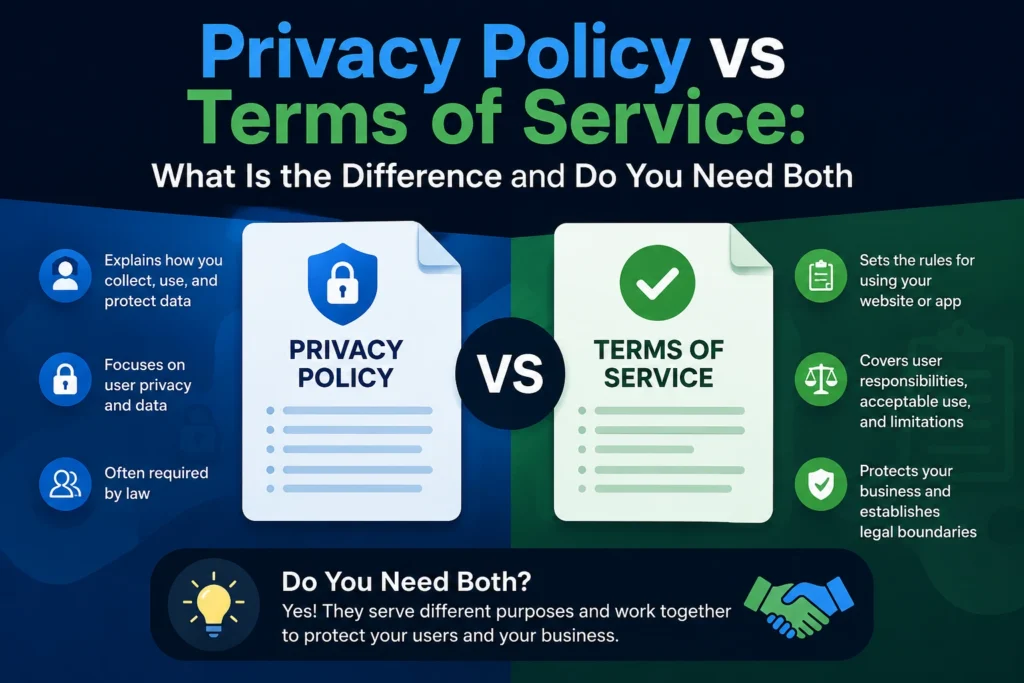
A privacy policy discloses what personal data a site collects, how it is used, with whom it is shared, and what rights visitors have regarding it. This is a legal disclosure document, not a marketing page. Laws in many regions require it as soon as a site collects any personal data.
This includes obvious data like names and emails from a contact form but also less obvious data like IP addresses, cookies, and analytics tracking that most sites collect by default through tools like Google Analytics.
- What data is collected and how
- Third-party data is shared with ad networks and analytics tools, including
- How visitors can request access to or deletion of their data
- Cookie usage and tracking technology disclosures
What Terms of Service Actually Covers
Terms of service set the rules for using a website or product, covering acceptable use, intellectual property ownership, liability limits, and what happens if those rules are broken. Unlike a privacy policy, terms of service are not legally required everywhere, but they offer real protection once published and agreed to.
A terms of service page is the document that lets a site owner say, in writing, that content cannot be scraped, accounts can be suspended for abuse, and the company is not liable for certain types of damages.
From experience, smaller business sites without any user accounts often skip terms of service entirely and rely on the privacy policy alone, while sites with logins, paid tools, or user-generated content almost always need both documents to actually cover their exposure.
The Core Differences Side by Side
A privacy policy is about data, while terms of service is about conduct and liability. A privacy policy is required by data protection law in most cases, while terms of service is more of a contractual choice a business makes to protect itself and set expectations with users.
| Aspect | Privacy Policy | Terms of Service |
|---|---|---|
| Covers | Data collection and use | Site usage rules and liability |
| Legally required | Usually yes, depending on region | Not universally required |
| Protects | The visitor’s data rights | The business from misuse and disputes |
| Typical trigger | Collecting any personal data | Having accounts, payments, or UGC |
Do you need both, or just one?
Almost every website with any kind of tracking, forms, or analytics needs a privacy policy. Terms of service become necessary once a site adds user accounts, payment processing, comments, or any feature where misuse could create a dispute. A simple brochure site can sometimes operate with a privacy policy alone.
91% of pages get zero organic traffic from Google, according to Ahrefs, and a meaningful share of that traffic ceiling has nothing to do with content quality and everything to do with trust signals search engines and visitors both look for, including the presence of basic legal pages.
From experience, I have seen affiliate sites lose ad network approval specifically because a reviewer could not find a privacy policy during a manual check, even though the content itself was strong enough to qualify otherwise.
Where to Place These Pages for Maximum Trust
Link both pages clearly in the website footer on every page, not buried in a single contact page. Search engines and ad network reviewers both check footer links as a baseline trust signal, and visitors expect to find them in the same place across every site they visit.
Backlinks remain one of Google’s top three ranking factors, but trust signals like accessible legal pages support the on-site half of the equation that link building alone cannot fix. Sites considered established and authoritative, generally those with a domain authority of 50 or higher according to Moz, almost universally have visible legal pages in their footer, and that is no coincidence.
Generating These Pages Without a Lawyer
Template-based generators can produce a solid baseline privacy policy and terms of service page for most small sites by answering a short set of questions about data collection and site features. Sites handling sensitive data categories or operating across multiple jurisdictions should still have a lawyer review the final result.
Our Legal Pages Generator builds both documents from a short questionnaire, giving smaller sites a real starting point instead of leaving the page blank or copying language from a competitor.
Frequently Asked Questions
Can one page cover both privacy policy and terms of service?
Technically yes, but separating them is clearer for visitors and easier to update independently as laws or features change.
Does a blog with no contact form need a privacy policy?
Almost always yes, since analytics tools and comment systems typically collect data like IP addresses even without a contact form.
Is terms of service the same as a disclaimer?
No, a disclaimer is usually a narrower statement about liability for specific content, while terms of service covers the full relationship between site and user.
Do AdSense and other ad networks check for these pages?
Yes, most ad networks and affiliate programs check for an accessible privacy policy during their review process before approval.
How often should these pages be updated?
Whenever data practices or site features change, and at minimum reviewed annually to stay aligned with current law.
Get Both Pages Done Properly
Our Legal Pages Generator creates both documents in minutes. Once your legal pages are live, run our Bulk DA PA Checker to see how trust signals line up against your authority metrics, and browse our SEO blog for more on-page trust factors worth fixing.